
Power That Performs, Air That Breathes
Reliable power backup is no longer just about keeping the lights on. In today’s environment-conscious and regulation-driven world, it is equally about how that power is produced. Diesel Generator (DG) sets continue to be the backbone of emergency and standby power across hospitals, IT parks, industries, commercial buildings, and residential communities—but their emissions have placed them under intense scrutiny.
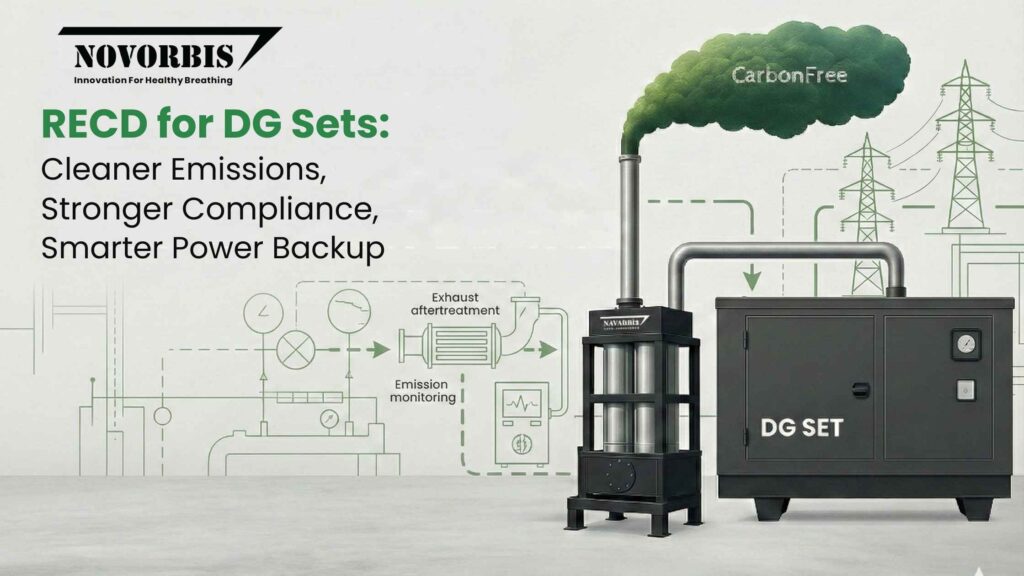
This is where RECD for DG Sets emerges as a game-changing solution. Retrofit Emission Control Devices (RECDs) are transforming conventional diesel power into a cleaner, compliant, and future-ready energy backup system—without compromising on reliability.
This blog takes a deep dive into how RECD-enabled DG sets work, why they are becoming essential in India, and how advanced technologies like ARAI-approved, filterless RECDs are redefining emission compliance at scale.
The Emission Challenge with Diesel Generator Sets
DG sets are indispensable during power outages, but they also emit pollutants that directly impact air quality, especially in urban and semi-urban areas. These emissions typically include:
- Particulate Matter (PM)
- Carbon Monoxide (CO)
- Hydrocarbons (HC)
- Nitrogen Oxides (NOx)
As cities become denser and pollution levels rise, authorities and communities are no longer willing to ignore these emissions. Backup power systems must now align with environmental responsibility.
RECD-Enabled DG Sets: A New Standard for Clean Backup Power
RECD-enabled DG sets represent a shift from reactive compliance to proactive sustainability. Instead of treating emission control as an afterthought, RECDs integrate directly into the exhaust system of diesel generators to treat emissions at the source.
The result is a three-fold advantage:
- Significant reduction in harmful exhaust emissions
- Strong alignment with Indian emission regulations
- Zero compromise on DG set performance and reliability
Across sectors—from healthcare to heavy industry—RECD for DG Sets has quickly become the new benchmark for responsible power backup.
Regulatory Compliance in India: Why RECD Matters
Emission standards for diesel generators in India are regulated by the Central Pollution Control Board (CPCB). These norms mandate strict limits on particulate matter and gaseous emissions, especially in urban and sensitive zones.
How RECD Ensures Compliance
Installing an RECD helps DG operators:
- Maintain emission levels within prescribed CPCB limits
- Stay inspection-ready with documented performance
- Avoid penalties, shutdown notices, and legal complications
One of the biggest advantages of RECD systems is their versatility—they can be installed on both new and existing DG sets, making compliance achievable without replacing expensive equipment.
How RECD Works: Cleaning Emissions at the Exhaust
The effectiveness of an RECD lies in its placement and design. Installed directly on the DG exhaust line, the device treats exhaust gases before they are released into the atmosphere.
Inside an RECD System
As exhaust gases pass through the RECD:
- Fine particulate matter and soot are captured
- Carbon monoxide and unburnt hydrocarbons are oxidized
- Nitrogen oxides are reduced
This process dramatically cuts visible smoke and toxic emissions, ensuring cleaner exhaust even during long or high-load operations.
Real-World Benefits Beyond Compliance
Cleaner Air Where It Matters Most
RECD solutions can reduce harmful emissions by up to 90%, making a measurable difference in air quality. This is especially critical for:
- Hospitals and healthcare facilities
- Residential complexes
- Schools, colleges, and commercial campuses
Lower Maintenance and Operating Costs
Cleaner exhaust translates to:
- Reduced soot buildup
- Less wear on exhaust components
- Stable engine combustion
Over time, this leads to lower maintenance costs and improved DG set lifespan.
Stronger ESG and Brand Credibility
Sustainability is no longer optional. Organizations that adopt RECD-enabled DG sets demonstrate a clear commitment to environmental responsibility, strengthening their ESG profile and public trust.
Choosing the Right RECD for Different DG Capacities
RECD systems are engineered to match specific DG capacities and operating conditions.
Small Capacity DG Sets (40 kVA–120 kVA)
Ideal for homes, clinics, retail outlets, and small offices, these systems use compact RECD units designed for quiet, low-emission operation in close-proximity environments.
Medium Capacity DG Sets (160 kVA–700 kVA)
Common in hospitals, hotels, IT parks, and educational institutions, these DG sets benefit from RECDs that can handle long runtimes and variable loads while maintaining consistent emission control.
Large Capacity DG Sets (1000 kVA–2500 kVA)
Used in data centers, industrial plants, and infrastructure projects, large DG sets require heavy-duty RECD systems capable of operating continuously under high exhaust temperatures and peak demand.
ARAI Type Approval: Raising the Bar for High-Capacity DG Compliance
While CPCB compliance is essential, ARAI Type Approval has emerged as a critical benchmark for medium- and large-capacity DG sets. Emission control at higher power ratings is far more complex due to increased exhaust volumes and thermal loads.
In this space, Novorbis has achieved a significant industry milestone.
The company has secured ARAI Type Approval for its complete RECD range from 100 kW to 771 kW, including approval of the 771 kW category on 19th December.
This approval validates:
- Emission performance under sustained high loads
- Thermal safety at elevated exhaust temperatures
- Compatibility with engines where failure risks are highest
It proves that high-capacity compliance is achievable without compromising reliability.
CarbonFree™: Filterless RECD Technology for Large DG Sets
One of the most notable innovations in this space is CarbonFree™, recognized as the world’s most compact, filterless RECD designed specifically for large DG sets in the 750 kVA to 910 kVA range.
Why Filterless Design Matters
Traditional filtration-based systems often face clogging over time, leading to increased backpressure and maintenance issues. CarbonFree™ eliminates this problem entirely.
By doing away with conventional filters, it ensures:
- Zero clogging risk
- Minimal maintenance requirements
- Near-zero exhaust backpressure, even at continuous high loads
There is no choking of the engine, no gradual performance loss—only steady, compliant operation.
Key Advantages of CarbonFree™
- ARAI-certified coverage from 100 kW to 771 kW
- Filterless design with no clogging
- Ultra-compact footprint for tight installations
- Minimal exhaust backpressure at peak loads
- Class 1 RECD classification with no secondary pollutants
- No silencer removal or additional support structures required
- Durable stainless-steel construction
This reflects a broader industry shift: emission control systems are now evaluated not just on reduction efficiency, but on how seamlessly they integrate into real-world operations.
Industry-Wise Applications of RECD
RECD technology delivers value across multiple sectors:
- Hospitals & Healthcare: Cleaner backup power protects patient health
- Educational Institutions: Low-emission environments for learning
- Corporate Offices & IT Parks: Compliance-driven reliability with sustainability credentials
- Manufacturing & Heavy Industry: Emission control under continuous high-load operations
- Residential Communities: Reduced smoke, odor, and resident complaints
Wherever uninterrupted power is critical, RECD fits naturally.
Installation, Integration, and Long-Term Reliability
A professionally designed RECD system integrates seamlessly with DG sets without affecting performance.
Proper installation ensures:
- Precision fitment on new or retrofit DG sets
- No impact on engine efficiency or output
- Low-maintenance, long-life operation
- Dependable after-sales support
Once installed, RECD systems typically require only routine inspections, making them a truly hassle-free compliance solution.
Choosing the Right RECD Partner in India
Technology alone is not enough—execution and experience matter.
Novorbis Itus delivers DG sets integrated with advanced RECD solutions across a wide capacity range.
With CPCB-aligned designs, proven field performance, and expert installation support, the company helps organizations meet emission norms without compromising power reliability.
FAQs: RECD for DG Sets
What does RECD stand for?
RECD stands for Retrofit Emission Control Device, designed to reduce harmful DG emissions.
Is RECD mandatory in India?
Yes, RECD is mandatory for many DG sets, particularly in regulated and urban zones, to meet CPCB norms.
Does RECD affect DG performance?
No. When properly engineered, RECD systems maintain engine efficiency and power output.
Can RECD be installed on older DG sets?
Yes. RECD solutions are suitable for both new and existing DG installations.
How much maintenance does an RECD require?
Minimal—usually limited to routine inspections.
Conclusion: Smarter Power for a Cleaner Future
At the intersection of power reliability and environmental responsibility lies a clear solution—RECD for DG Sets: Cleaner Emissions, Stronger Compliance, Smarter Power Backup.
By combining advanced emission control with dependable diesel generation, organizations no longer have to choose between uptime and clean air. They get both.
From residential complexes to large industrial facilities, RECD-enabled DG sets deliver confidence, compliance, and credibility—today and for the future.
That’s not just backup power.
That’s power done right.