
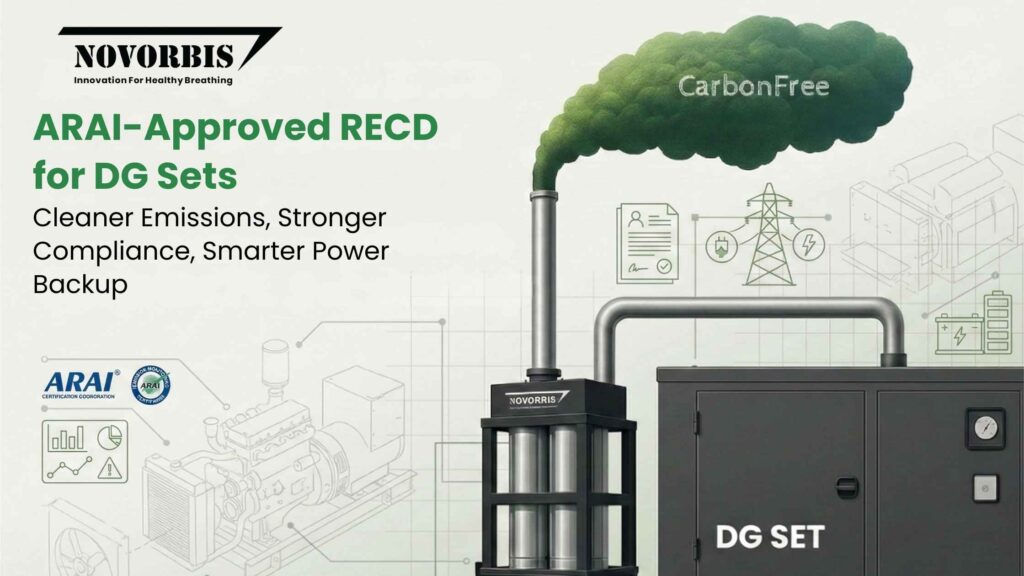
Power That Never Blinks—Compliance That Never Fails
Let’s face it—when the grid goes dark, business can’t afford to blink. From hospitals in the middle of critical surgeries to data centers running mission-critical workloads, reliable power backup is no longer a luxury. It’s a lifeline.
Across India, diesel generator (DG) sets continue to shoulder this responsibility. But today, reliability alone isn’t enough. Stricter emission enforcement has fundamentally changed how DG sets are allowed to operate.
Compliance is no longer optional. It is monitored, audited, and enforced—often without warning.
This is where ARAI-Approved RECD for DG Sets: Cleaner Emissions, Stronger Compliance, Smarter Power Backup becomes indispensable.
Retrofit Emission Control Devices (RECDs), tested and certified by Automotive Research Association of India (ARAI), are engineered to drastically reduce harmful emissions without compromising DG performance or reliability.
In simple terms:
✔ You keep the lights on
✔ You stay on the right side of regulators
This blog explores how ARAI-approved RECDs work, why ARAI Type Approval is now the industry benchmark, how high-capacity compliance is reshaping the market, and how advanced technologies are redefining emission control for large DG sets.
Understanding the Role of ARAI-Approved RECD in Modern DG Operations
Diesel generators are dependable workhorses—but they are also major sources of pollution. Key emissions include:
- Particulate Matter (PM)
- Nitrogen Oxides (NOx)
- Carbon Monoxide (CO)
- Unburnt Hydrocarbons (HC)
These pollutants directly contribute to smog, respiratory illness, and regulatory action.
An ARAI-approved RECD integrates seamlessly into the DG exhaust system and treats emissions at the source—without choking engine performance or increasing fuel consumption.
Approval from ARAI confirms that the RECD has passed stringent:
- Endurance tests
- Thermal stress tests
- Emission reduction benchmarks
—all aligned with Central Pollution Control Board (CPCB) norms.
The result?
A conventional DG set transformed into a compliant, future-ready asset—with no grey areas.
Why ARAI Approval Is the Gold Standard
ARAI approval isn’t a formality. It’s proof.
Certified RECDs undergo exhaustive evaluation under real Indian operating conditions, including:
- Continuous endurance testing across fluctuating loads
- Thermal validation in high ambient temperatures
- Exhaust back-pressure analysis to protect engine life
- Emission benchmarking against CPCB limits
Why This Matters
ARAI approval ensures:
- Seamless acceptance during pollution inspections
- Alignment with CPCB and state enforcement agencies
- Confidence for EPC contractors and consultants
- Protection from fines, shutdowns, and NOC cancellations
For organizations operating multiple DG sets across regions, ARAI approval brings standardization at scale—one benchmark, one assurance, everywhere.
ARAI Type Approval & the Shift Toward High-Capacity Compliance
Beyond CPCB compliance, ARAI Type Approval has emerged as a critical benchmark—especially for medium- and large-capacity DG sets where emission control becomes technically challenging.
In this space, Novorbis has achieved a major milestone by securing ARAI Type Approval for its complete RECD range from 100 kW up to 771 kW, including approval for the 771 kW category on 19th December.
What This Approval Validates
- Emission performance under sustained high loads
- Thermal safety at elevated exhaust temperatures
- Engine compatibility where conventional systems fail
This signals a decisive industry shift:
High-capacity power backup must now meet the same environmental rigor as smaller systems—without compromise.
Emission Performance That Stands Up to Inspection
This isn’t theory. It’s performance proven on the ground.
ARAI-Approved RECD for DG Sets consistently delivers:
- Up to 99.9% reduction in particulate matter (PM)
- Up to 95% reduction in NOx emissions
- Significant reduction in CO and HC
- Stable exhaust back-pressure within engine-safe limits
In Tier-1 and Tier-2 cities—where non-compliant DG sets face restrictions or bans—these results ensure:
✔ Uninterrupted operations
✔ Zero last-minute shutdowns
✔ Complete peace of mind
CarbonFree™: Compact, Filterless & Built for Large DG Sets
One of the most significant advancements in this space is CarbonFree™—recognized as the world’s most compact, filterless RECD designed specifically for large DG sets in the 750 kVA and 910 kVA range.
By eliminating traditional filtration bottlenecks, CarbonFree™:
- Prevents clogging
- Minimizes maintenance
- Maintains near-zero exhaust back-pressure—even at high loads
Key Advantages
- ARAI-certified coverage from 100 kW to 771 kW
- Filterless design with no soot accumulation
- Ultra-compact footprint
- Class 1 RECD (no secondary pollutants)
- No silencer removal or extra support structures
- Stainless-steel construction for long-term durability
This reflects a new industry reality:
Compliance must never come at the cost of uptime, space, or reliability.
How an RECD Works Inside a DG Exhaust System
Installed directly on the exhaust line, an RECD treats emissions before they are released into the atmosphere.
Core Functional Stages
1. Particulate Management
Captures soot and fine particles at micron and sub-micron levels—where health risks are highest.
2. Catalytic Conversion
Converts toxic gases into less harmful compounds through controlled chemical reactions.
3. Advanced NOx Control (Optional)
Enhanced nitrogen oxide reduction for high-load or urban deployments.
4. Smart Monitoring (OBD)
AI-enabled diagnostics monitor temperature, pressure, and system health in real time.
The outcome: cleaner exhaust, protected engines, and compliance that lasts.
Built for Real-World Operations—Not Just the Lab
ARAI-approved RECDs are engineered for demanding environments such as:
- Hospitals
- Manufacturing plants
- IT parks & data centers
- Infrastructure and construction sites
Design Highlights
- Corrosion-resistant stainless-steel housing
- Integrated temperature & pressure sensors
- AI-enabled onboard diagnostics
- Engine-safe back-pressure architecture
- Compatibility from 62.5 kVA to 2500 kVA
- Rapid retrofit with minimal downtime
Regulatory Mandates Driving RECD Adoption in India
Across Delhi NCR, Mumbai, Bengaluru, Chennai, and other metros, pollution control authorities now permit DG operation only with ARAI-approved emission control devices installed.
Non-compliance can result in:
- Heavy monetary penalties
- Immediate DG shutdown orders
- Revocation of Pollution NOCs
- Operational and reputational damage
Proactive adoption keeps organizations ahead of enforcement—not scrambling after notices.
Sector-Wise Applications of ARAI-Approved RECD
RECDs are now standard across emission-sensitive sectors:
- Manufacturing & industrial estates
- Hospitals & healthcare campuses
- IT parks & data centers
- Commercial offices & corporate parks
- Retail malls & mixed-use developments
- Educational institutions
- Infrastructure & construction projects
Every sector benefits from cleaner exhaust, regulatory security, and stronger ESG performance.
Cost Perspective: Compliance That Pays Back
While RECD costs vary based on DG capacity and configuration, the economics are compelling:
- Avoidance of fines and shutdowns
- Extended DG usability in restricted zones
- Improved ESG and sustainability credentials
- Eligibility for structured AMC and incentive programs
In most cases, the cost of compliance is far lower than the cost of disruption.
Operational Advantages Beyond Compliance
Installing an ARAI-approved RECD delivers benefits beyond regulation:
- Enhanced credibility with regulators and stakeholders
- Cleaner ambient air within premises
- Contribution to urban air-quality improvement
- Alignment with CSR and ESG commitments
- Marginal fuel-efficiency gains in optimized systems
Sometimes, doing the right thing is also the smartest decision.
Frequently Asked Questions (FAQs)
What is an RECD?
A Retrofit Emission Control Device installed on DG exhaust systems to control PM, NOx, CO, and HC emissions.
Is RECD mandatory in India?
Yes. In many urban and industrial zones, CPCB norms require ARAI-approved RECDs for legal DG operation.
Can older DG sets be retrofitted?
Absolutely. RECDs are compatible with DG sets from 62.5 kVA to 2500 kVA.
How is performance monitored?
AI-based OBD panels track pressure, temperature, and system health in real time.
Moving Forward with Cleaner, Compliant Power Backup
There’s no sugarcoating it—emission norms are tightening, enforcement is accelerating, and accountability is unavoidable. But this isn’t a setback. It’s an opportunity.
ARAI-Approved RECD for DG Sets: Cleaner Emissions, Stronger Compliance, Smarter Power Backup offers a proven, scalable, and future-ready path forward.
With innovations like CarbonFree™ and ARAI Type Approval for high-capacity systems, compliance no longer means compromise.
Cleaner emissions are no longer optional—they’re the new standard.
And honestly? It’s about time.