
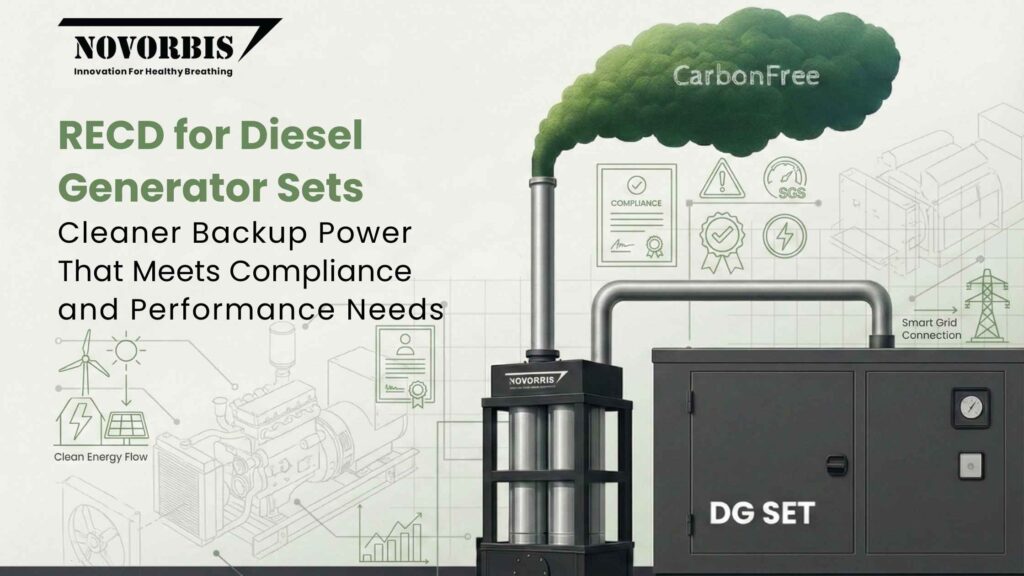
Power Continuity Meets Environmental Responsibility
Let’s face it—power cuts don’t ask for permission. They simply arrive.
And when they do, diesel generator (DG) sets step in as silent protectors across industrial clusters, urban infrastructure, healthcare campuses, and technology hubs. They keep production lines moving, servers alive, surgeries uninterrupted, and essential services functional.
But there’s an uncomfortable truth we can no longer ignore.
Every time a DG set operates without proper emission control, it releases particulate matter (PM), nitrogen oxides (NOx), hydrocarbons (HC), and carbon monoxide (CO) directly into the surrounding air. In dense cities and industrial zones, this invisible exhaust quietly degrades air quality and public health.
With stricter oversight from the Central Pollution Control Board (CPCB) and rising environmental accountability, organizations are now expected to ensure power continuity with responsibility.
That’s exactly where RECD for Diesel Generator Sets emerges as a practical, scalable, and field-proven solution—allowing industries to control air pollution without compromising uninterrupted power.
Why Diesel Generator Emissions Can’t Be Ignored Anymore
Across India’s fast-growing cities and industrial corridors, DG sets are no longer optional—they’re essential. Yet unmanaged emissions contribute directly to:
- Rising urban smog and poor AQI levels
- Increased respiratory and cardiovascular illnesses
- Dangerous exposure to PM₂.₅ and PM₁₀ in workplaces and residential areas
- Regulatory penalties, shutdown notices, and compliance risks
DG emissions are no longer “background pollution.”
They are a controllable operational risk, and regulators, investors, and communities now expect visible action.
Understanding RECD in Real-World Application
RECD (Retrofit Emission Control Devices) are not experimental technologies or lab concepts. They are engineered exhaust after-treatment systems designed specifically to be retrofitted onto existing diesel generator sets.
Installed inline with the DG exhaust, RECD systems:
- Capture and retain harmful particulate matter
- Oxidize toxic gases before release into the atmosphere
- Maintain stable generator performance through intelligent regeneration
Unlike improvised silencers or basic filters, RECDs are purpose-built for long-duty industrial use, durability, and regulatory compliance. Their adoption directly aligns with CPCB mandates—especially for DG sets rated 125 kVA and above in notified zones.
Emission Control Outcomes That Actually Matter
Ultra-High Particulate Matter Reduction
Modern RECD systems achieve up to 99.9% reduction in particulate matter, including PM₂.₅ and PM₁₀.
This is not theoretical—it’s measured, verified, on-ground performance.
This drastic reduction lowers exposure linked to:
- Asthma and chronic bronchitis
- Heart disease and stroke
- Long-term respiratory damage
Cleaner exhaust translates directly into healthier surroundings.
Controlled NOx, HC, and CO Emissions
Through optimized exhaust flow design and catalytic oxidation, RECDs significantly reduce:
- Carbon monoxide (CO)
- Unburnt hydrocarbons (HC)
- Nitrogen oxides (NOx), a key contributor to smog formation
The result is visibly cleaner exhaust and measurably safer air.
Stable Performance Under Variable Load
DG sets rarely operate at constant loads. RECD systems are engineered to handle:
- Sudden load fluctuations
- Wide exhaust temperature ranges
- Extended runtime during outages
Emission control never comes at the cost of reliability—because power continuity is non-negotiable.
How RECD Works: A System-Level Breakdown
1. High-Efficiency Filtration
Soot and particulate matter are trapped using high-temperature, multi-layer filtration media designed for diesel exhaust conditions.
2. Catalytic Oxidation
CO and HC gases are chemically converted into less harmful compounds before release.
3. Regeneration & Clogging Prevention
Thermal or assisted regeneration prevents clogging and excessive back pressure, ensuring consistent performance.
4. Real-Time Monitoring (OBD Integration)
Advanced RECDs feature onboard diagnostics to monitor exhaust temperature, pressure, and system health—enabling predictive maintenance.
Compliance, ESG, and Operational Advantage
Regulatory Assurance
Installing RECD ensures alignment with CPCB emission norms—protecting operations from penalties, shutdowns, and approval delays.
ESG & Sustainability Alignment
RECD adoption supports:
- Improved local air quality
- Measurable environmental impact
- Stronger ESG disclosures and audits
This is sustainability you can prove, not just claim.
Asset Longevity
By controlling soot buildup and exhaust back pressure, RECDs support better engine health and extend DG lifespan—improving long-term efficiency.
ARAI Type Approval & High-Capacity Compliance
Beyond CPCB requirements, Automotive Research Association of India (ARAI) Type Approval has become a critical benchmark—especially for medium- and large-capacity DG sets.
In this space, Novorbis has achieved ARAI Type Approval for its complete RECD range from 100 kW to 771 kW, including the 771 kW category approved on 19th December.
This validates:
- Emission performance under high load
- Thermal safety and durability
- Engine compatibility at higher power ratings
It signals a clear industry shift toward robust, large-scale emission control solutions.
CarbonFree™: Compact, Filterless & Built for Large DG Sets
A standout innovation in this evolution is CarbonFree™—recognized as the world’s most compact, filterless RECD, designed for 750 kVA and 910 kVA DG sets.
By eliminating traditional filtration bottlenecks, CarbonFree™ avoids clogging, minimizes maintenance, and maintains near-zero exhaust backpressure—even during continuous high-load operation.
Key Advantages of CarbonFree™
- ARAI-certified coverage from 100 kW to 771 kW
- Filterless design with no clogging risk
- Ultra-compact footprint
- Minimal exhaust backpressure
- Class 1 RECD classification (no secondary pollutants)
- No silencer removal or additional structures
- Stainless-steel construction for durability
Where RECD Installation Is Critical
RECD adoption is rapidly becoming the baseline across:
- Manufacturing plants
- IT parks and data centers
- Hospitals and healthcare campuses
- Universities and institutions
- Government buildings and utilities
- Construction and real estate projects
- Commercial complexes and malls
In these environments, RECD for Diesel Generator Sets is no longer optional—it’s essential.
Retrofitting Without Disruption
One of RECD’s biggest advantages is practicality.
Existing DG sets—new or aging—can be upgraded without structural modification or generator replacement. Installation timelines are optimized to minimize downtime.
No drama. No prolonged shutdowns.
Just cleaner, compliant power.
Maintenance & Lifecycle Management
RECD systems are designed for real-world industrial conditions:
- Scheduled inspections and cleaning
- Automated regeneration alerts
- Long operational life under heavy usage
With OBD monitoring, maintenance becomes predictable, reducing surprise failures and compliance risks.
Addressing Noise Alongside Emissions
While emission reduction is the primary goal, optimized RECD housings often reduce exhaust noise as well—an added benefit for urban, commercial, and healthcare environments.
Strategic Impact on Business Operations
Installing RECD goes beyond compliance. It delivers real business value:
- Cleaner air inside and outside facilities
- Stronger inspection and audit outcomes
- Improved eligibility for green tenders
- Enhanced brand credibility and trust
Emission control stops being a burden—and becomes a strategic asset.
Frequently Asked Questions (FAQs)
Can older DG sets be upgraded with RECD?
Yes. RECDs are engineered for retrofitting across DG ages and capacities.
Is RECD mandatory everywhere?
Mandates apply to DG sets ≥125 kVA in notified zones, with enforcement expanding steadily.
Does RECD affect fuel consumption or power output?
Properly designed systems maintain optimal exhaust flow without performance loss.
How often is maintenance required?
Maintenance depends on runtime and load profile. OBD alerts guide timely servicing.
The Road Ahead: Cleaner Backup Power Is Here
As urban density increases and industrial activity accelerates, unmanaged DG emissions are no longer acceptable—or necessary.
RECD adoption allows organizations to retain power reliability while decisively cutting air pollution, aligning compliance, sustainability, and operational efficiency into one scalable solution.
Cleaner backup power isn’t a distant goal.
With RECD for Diesel Generator Sets, it’s practical, proven, and achievable—right now.
And honestly? That’s progress worth investing in.