
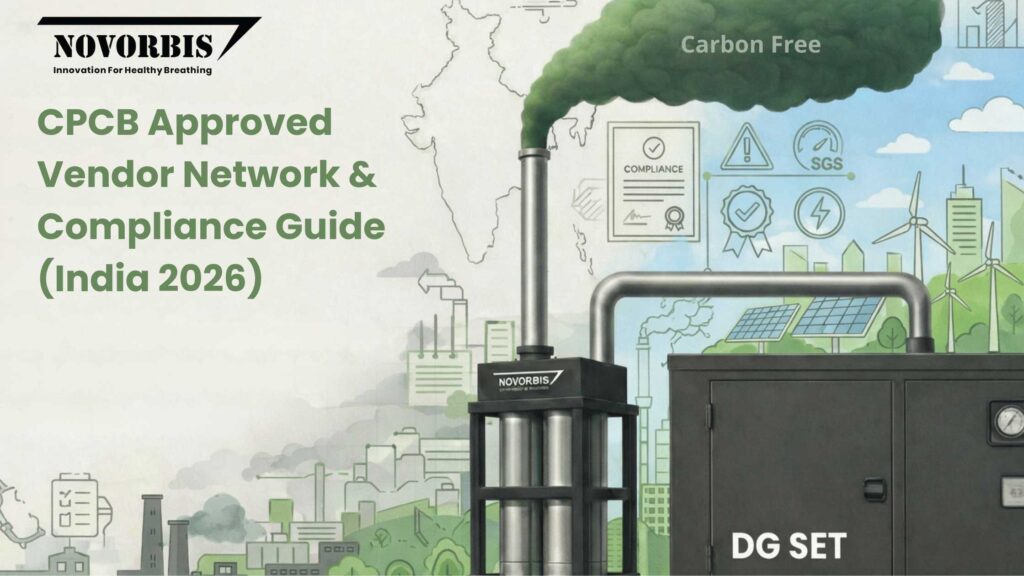
Why CPCB Compliance Is No Longer Optional for Indian Industries
Across India, environmental compliance has moved from paperwork to active enforcement. Industries that once treated pollution control as a secondary concern are now facing inspections, notices, penalties, and operational shutdowns from regulatory bodies like the Central Pollution Control Board (CPCB) and the National Green Tribunal (NGT).
One major reason behind this shift is the significant pollution caused by in-use diesel generators (DG sets). These machines remain vital for power backup across industries, hospitals, commercial complexes, and construction projects — especially in areas with unreliable grid supply. But they also emit harmful pollutants such as particulate matter (PM), nitrogen oxides (NOx), carbon monoxide (CO), and hydrocarbons (HC), making them one of the largest stationary pollution sources in urban and industrial settings.
Several independent studies show how substantial DG emissions are:
- In cities struggling to meet air quality targets, DG sets can contribute approximately 7% to 18% of total particulate matter pollution (PM) — a major factor in dangerous smog episodes.
- In the state of Haryana alone, DG sets emitted over 1,121 tonnes of PM2.5 pollutants in 2022, with medium- and large-capacity generators accounting for the majority of this output.
- National data indicates millions of tonnes of NOx emissions annually from DG sets operating across the country, reinforcing their role as significant pollution sources.
Recognising this, regulatory frameworks like CPCB’s DG set emission standards (including CPCB IV+ norms) have introduced stringent limits for PM, NOx, CO, and HC emissions from new and existing generators. These standards aim to align emissions with public health and environmental goals, while also guiding retrofitting requirements for older machines.
To enforce these norms effectively, India’s regulators have tightened emission rules and shifted responsibility directly to businesses. Today, compliance is not just about installing any pollution-control equipment. It’s about working only with CPCB-approved vendors, deploying verified technologies like Retrofit Emission Control Devices (RECDs), and maintaining documented, demonstrable compliance for regulatory inspections.
This makes the concept of a CPCB Approved Vendor Network critical for industries — not just for environmental responsibility, but for legal protection and operational continuity.
This guide explains:
- What CPCB approval really means
- Why vendor approval is central to compliance
- How CPCB-approved vendor networks work
- The risks of choosing non-approved vendors
- How industries can stay compliant long-term
All explained in simple, practical language for decision-makers.
What Does “CPCB Approved” Actually Mean?
The Central Pollution Control Board is India’s apex body for environmental regulation. It sets emission standards, issues technical guidelines, and authorises pollution-control technologies used across the country.
When a vendor or solution is described as “CPCB approved”, it does not mean marketing approval. It means:
- The technology has been tested as per CPCB protocols
- Emission reduction performance meets minimum mandated standards
- Documentation has been reviewed and accepted
- The solution is considered technically compliant for regulatory use
In the case of diesel generators, CPCB approval is especially important for:
- Retrofit Emission Control Devices (RECDs)
- Emission reduction systems installed on in-use DG sets above 125 kVA
Simply installing a device is not enough.
Who supplies it, how it is tested, and how it is documented all matter.
Why Vendor Approval Is Central to CPCB Compliance
Many industries assume compliance depends only on equipment performance. In reality, compliance is vendor-dependent.
Here’s why:
- CPCB and State Pollution Control Boards (SPCBs) verify vendor credentials
- During inspections, authorities ask:
- Who supplied the device?
- Is the vendor CPCB-recognised?
- Are approval documents traceable?
- Who supplied the device?
- If the vendor is not approved or verification fails, the installation may be rejected—even if the equipment “works”
This makes vendor selection as important as technology selection.
A CPCB-approved vendor typically provides:
- Valid approval or reference documentation
- Test reports aligned with CPCB protocols
- Installation and commissioning records
- Support during inspections and audits
Without this, industries risk non-compliance despite investment.
How CPCB Approval Is Granted to RECD Vendors
CPCB does not approve vendors casually. The process is technical, data-driven, and evidence-based.
While details vary by technology, the general framework includes:
1. Technology Evaluation
The RECD or emission control system is evaluated for:
- Particulate Matter (PM) reduction
- Exhaust flow compatibility
- Engine backpressure impact
- Operational safety
2. Performance Testing
Testing is conducted under defined conditions to verify:
- Minimum 70% PM reduction (as mandated)
- Consistency across operating loads
- Durability over time
3. Documentation Review
Vendors submit:
- Test reports
- Technical specifications
- Installation methodology
- Maintenance guidelines
4. Regulatory Acceptance
If performance aligns with CPCB criteria, the technology is considered approved or acceptable for compliance use.
This process ensures that only verified solutions enter the compliance ecosystem.
The Role of the National Green Tribunal in Enforcement
While CPCB sets standards, enforcement has accelerated due to the National Green Tribunal.
NGT has:
- Mandated RECD installation for DG sets above 125 kVA
- Directed SPCBs to conduct inspections
- Allowed penalties, sealing, and shutdowns for non-compliance
As a result:
- Compliance timelines are shorter
- Excuses based on “lack of clarity” are no longer accepted
- Vendor documentation is routinely scrutinised
This makes working with CPCB-aligned vendors essential, not optional.
Risks of Choosing Non-CPCB Approved or Unverified Vendors
Many businesses fall into compliance traps by choosing vendors based only on:
- Lower cost
- Faster installation promises
- Aggressive marketing claims
This can be extremely risky.
Common Risks Include:
- Inspection failure due to unverifiable approval
- Rejection of installation by SPCB officials
- Re-installation costs
- Financial penalties
- Generator sealing or operational restrictions
In worst cases, businesses discover after installation that the vendor’s “approval” is self-declared or outdated.
A CPCB-approved vendor network reduces these risks by ensuring regulatory alignment from day one.
Industries That Must Prioritise CPCB Approved Vendors
While CPCB norms apply broadly, enforcement is especially strict for:
- Manufacturing units
- Industrial estates
- Hospitals and healthcare facilities
- IT parks and data centres
- Malls, hotels, and commercial complexes
- Construction and infrastructure projects
Any facility operating DG sets of 125 kVA and above — particularly in non-attainment or regulated air quality areas — must ensure vendor compliance with CPCB emission control mandates.
How to Verify CPCB Approval: What Authorities Look For
During inspections, regulators typically verify:
- Vendor name and traceability
- Technology reference documents
- Test reports aligned with CPCB guidelines
- Installation certificates
- Maintenance and operation records
This is why credible vendors proactively provide verification-ready documentation rather than vague assurances.
(This section will internally link to the supporting blog: How to Verify CPCB Approved RECD Vendors in India)
How CPCB Approved Vendor Networks Simplify Compliance
Working with an approved vendor network offers clear advantages:
1. Faster Compliance
Approved vendors understand timelines, paperwork, and inspection expectations.
2. Lower Legal Risk
Reduced chances of rejection, penalties, or notices.
3. Long-Term Reliability
Proven technologies mean consistent emission control.
4. Better Inspection Support
Experienced vendors assist during audits and regulatory interactions.
5. Cost Efficiency Over Time
Avoids rework, re-installation, and downtime costs.
For industries, this shifts compliance from a reactive burden to a managed process.
Common CPCB Compliance Mistakes Industries Make
Despite clear guidelines, many businesses struggle due to avoidable errors:
- Choosing vendors without verifiable approval
- Treating RECD installation as a one-time task
- Ignoring documentation and record-keeping
- Delaying action until notices are issued
- Assuming all “RECDs” are automatically compliant
A CPCB-approved vendor network helps eliminate these blind spots.
CPCB Compliance Is a System, Not a Single Device
One of the biggest misconceptions is that installing an RECD alone guarantees compliance.
In reality, CPCB compliance depends on:
- Technology performance
- Vendor approval
- Installation quality
- Ongoing operation
- Documentation readiness
A vendor network integrates all these elements into a single, auditable system.
The Strategic Advantage of Early Compliance
Industries that act early benefit from:
- More vendor choices
- Better installation timelines
- Lower compliance stress
- Positive regulatory relationships
Late adopters often face:
- Rushed installations
- Limited vendor availability
- Higher costs
- Increased scrutiny
In 2026 and beyond, compliance readiness will directly impact business continuity.
Final Thoughts: CPCB Approved Vendor Networks Are the Foundation of Compliance
Environmental compliance in India has entered a new phase—enforcement-driven, vendor-verified, and data-backed.
A CPCB Approved Vendor Network is not just about meeting today’s norms. It is about:
- Future-proofing operations
- Reducing regulatory risk
- Protecting investments
- Demonstrating responsible business practices
To summarise:
- CPCB approval defines what is acceptable—not marketing claims
- Vendor credibility is central to compliance success
- Networks provide structure, reliability, and long-term support
- The cost of non-compliance is far higher than the cost of doing it right
Understanding and working within a CPCB-approved vendor ecosystem is now the smartest, safest path to emission compliance in India.