
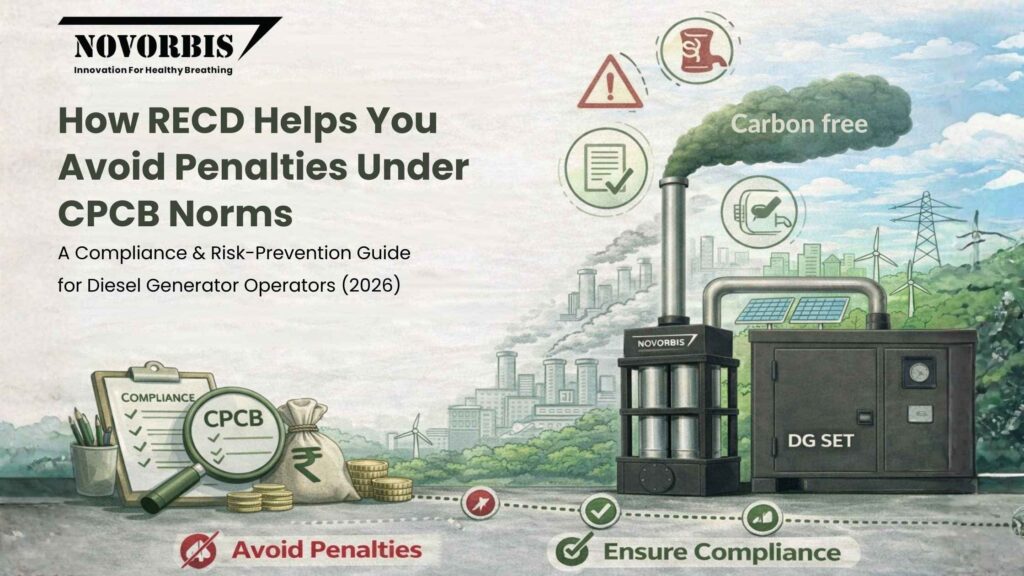
A Compliance & Risk-Prevention Guide for Diesel Generator Operators (2026)
In 2025 and beyond, diesel generator (DG) compliance in India is no longer a passive requirement — it is actively enforced.
Under updated emission enforcement mechanisms guided by the Central Pollution Control Board (CPCB) and monitored through directives from the National Green Tribunal, industries operating DG sets above regulated capacity thresholds face measurable compliance exposure.
The most common question decision-makers now ask:
What is the CPCB penalty for DG set non-compliance — and how can we avoid it?
This guide explains:
- What CPCB 2025 norms require
- What penalties may apply
- How inspections are conducted
- How installing an RECD protects operations
- Why compliance is cheaper than litigation
What Do CPCB 2025 Norms Require for DG Sets?
Under current enforcement practices, in-use DG sets — particularly those above 125 kVA — must demonstrate:
- Significant reduction in particulate matter (PM) emissions
- Installation of compliant emission control solutions
- Proper documentation and traceability
- Inspection readiness
Failure to meet these requirements may trigger enforcement action.
To understand installation cost, lifecycle savings, and full ROI comparison, explore our complete guide on RECD Installation, Cost & ROI in India (2026 Guide).
What Is the CPCB Penalty for DG Set Non-Compliance?
While penalty amounts may vary by state and enforcement severity, non-compliance can lead to:
- ₹50,000+ monthly environmental compensation (in some regions)
- Generator sealing
- Operational hour restrictions
- Show-cause notices
- Legal proceedings
- Environmental litigation exposure
For industries running 250 kVA or 500 kVA DG sets daily, even short-term shutdown can cause significant revenue disruption.
Penalties are not the only risk — operational interruption is often more damaging.
How Inspections Typically Work in 2026
State Pollution Control Boards (SPCBs) may:
Conduct surprise site visits
Request emission control documentation
Verify RECD installation
Check capacity matching
Review maintenance logs
Inspectors do not evaluate visual smoke alone. They verify documentation and system traceability.
If documentation is weak or absent, compliance may be rejected.
How Installing an RECD Prevents CPCB Penalties
A properly installed, capacity-matched RECD helps avoid penalties by:
Achieving mandated ≥70% PM reduction
Demonstrating proactive compliance
Providing inspection-ready documentation
Reducing visible emissions
Showing regulatory responsibility
But not all RECD installations provide equal protection.
Correct selection is critical.
To ensure your system is technically compliant and inspection-ready, read How to Choose the Right Retrofit Emission Control Device for Your DG Set.
Compliance vs Penalty: A Financial Comparison
Let’s compare risk vs investment.
Example: 250 kVA DG
RECD Installation Cost: ₹7 lakh
Potential Penalty: ₹50,000/month
If enforcement continues for 12 months:
₹50,000 × 12 = ₹6 lakh
This nearly equals installation cost — without including:
- Downtime losses
- Administrative cost
- Legal consultation
- Production impact
- Reputation damage
Compliance is a fixed investment. Penalties are unpredictable liabilities.
For a detailed cost breakdown across DG capacities and lifecycle budgeting, review RECD Price in India (2026 Guide).
Why Waiting for a Notice Is Risky
Some industries delay installation until receiving an official notice.
This approach creates risk:
- Short compliance deadlines
- Limited vendor availability
- Emergency installation premiums
- Higher inspection scrutiny
Proactive compliance reduces pressure and cost escalation.
Additional Risks of Non-Compliance
Beyond fines, industries face:
- ESG reporting impact
- Investor scrutiny
- Insurance complications
- Reputational damage
- Worker safety concerns
In regulated sectors, compliance credibility affects long-term business stability.
What Makes an RECD Installation Legally Protective?
To effectively prevent penalties, an RECD must:
Match DG capacity exactly
Maintain safe backpressure
Provide authentic emission test reports
Include commissioning documentation
Be supported during inspection
Poorly documented systems may still fail compliance review.
For pricing and lifecycle analysis, read:
👉 RECD Price in India – Cost Factors, Installation & Maintenance
Case Example: Avoiding Enforcement Action
A manufacturing facility operating a 125 kVA DG in a monitored industrial zone received advisory notice.
Actions taken:
- Installed capacity-matched RECD
- Completed commissioning documentation
- Maintained inspection file
Outcome:
No penalty issued
No shutdown
Inspection cleared
Operational continuity maintained
Proactive compliance prevented financial disruption.You can review the complete installation and inspection journey in our detailed 125 kVA RECD Installation Case Study.
The 2026 Compliance Strategy Framework
Industries should follow a structured approach:
Assess enforcement risk in your location
Confirm DG capacity and operating pattern
Select compliant RECD technology
Install with proper commissioning
Maintain documentation
Prepare for inspection
Structured compliance reduces uncertainty.
The Real Cost of Non-Compliance
Non-compliance cost includes:
- Monthly penalties
- Production downtime
- Legal fees
- Emergency compliance cost
- Reputation impact
- Administrative strain
When viewed holistically, compliance becomes a financial shield.
Final Takeaway: RECD Is Risk Mitigation
Under CPCB 2025 enforcement norms, RECD installation is:
A compliance safeguard
A financial protection strategy
A continuity insurance tool
A regulatory credibility asset
The decision is not:
“Can we afford an RECD?”
The decision is:
“Can we afford regulatory exposure?”
Industries that act early protect revenue, reputation, and operational stability.
Quick FAQs
Q1: What is the CPCB penalty for DG set non-compliance?
Penalties may include monthly environmental compensation, generator sealing, or operational restrictions, depending on enforcement severity.
Q2: Is RECD mandatory for DG sets above 125 kVA?
In many regulated areas, DG sets above 125 kVA must comply with emission norms enforced by CPCB and SPCBs.
Q3: Does installing an RECD guarantee compliance?
Only if it is capacity-matched, properly installed, and supported by valid documentation.
Q4: How quickly can penalties be imposed?
Enforcement timelines vary, but notice-to-action periods are often short in regulated zones.
Q5: Is compliance cheaper than paying penalties?
In most scenarios, yes. Penalties, downtime, and legal exposure often exceed installation cost within 12–24 months.