
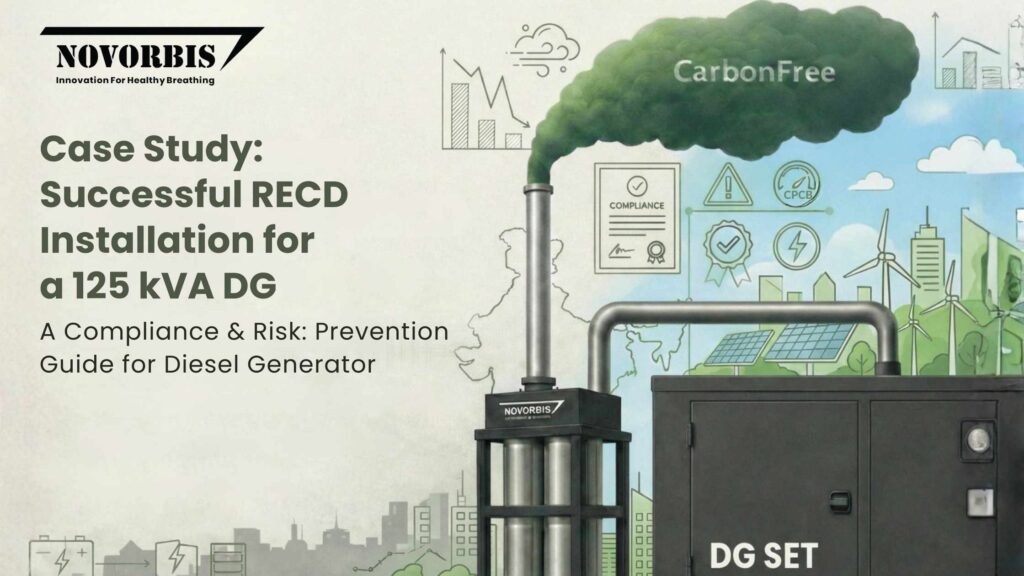
How a Mid-Sized Industrial Facility Achieved CPCB Compliance Without Operational Disruption (2026)
When enforcement under updated emission norms intensified, a mid-sized manufacturing facility operating a 125 kVA diesel generator faced a familiar dilemma:
- Install a Retrofit Emission Control Device (RECD) immediately
- Or risk penalties, inspection notices, and possible generator sealing
This real-world RECD installation case study explains how the facility:
Evaluated compliance risk
Selected the right RECD technology
Completed installation within timeline
Passed inspection
Achieved ROI within 18 months
This example provides practical clarity for industries planning RECD deployment.For a complete financial and compliance evaluation framework, refer to our detailed guide on RECD Installation, Cost & ROI in India (2026 Guide).
Facility Background
- Industry Type: Medium-scale manufacturing unit
- Location: Industrial cluster under active environmental monitoring
- DG Capacity: 125 kVA
- Usage Pattern: 6–8 hours daily backup operation
- Compliance Risk Level: High
The facility had operated the generator for several years without emission control retrofit.
With increased inspections from authorities aligned with the Central Pollution Control Board, management recognized proactive action was necessary.
Step 1: Compliance Risk Assessment
The facility evaluated:
- DG capacity (above regulated threshold)
- Inspection frequency in industrial cluster
- Potential penalty exposure
- Production downtime risk
Estimated penalty exposure:
₹50,000 per month (if non-compliant)
Management concluded that waiting for a formal enforcement order would increase risk and cost.
To understand the regulatory exposure that triggered this decision, review How RECD Helps You Avoid Penalties Under CPCB 2025 Norms.
Step 2: Technology Selection
The technical team evaluated:
- Filter-based RECD
- Filter-less RECD
Given daily usage of 6–8 hours and limited maintenance staff, the facility chose a low-maintenance filter-less RECD system to reduce long-term intervention.
Key decision factors:
Minimal downtime
No regeneration cycles
Reduced clogging risk
Lower 5-year lifecycle cost
To understand how technology selection affects long-term compliance success, read How to Choose the Right Retrofit Emission Control Device for Your DG Set.
Step 3: Cost & Budget Planning
Project Cost Breakdown
| Component | Cost |
| RECD Equipment | ₹4.8 lakh |
| Installation & Fabrication | ₹80,000 |
| Compliance Documentation | Included |
| Total Project Cost | ₹5.6 lakh |
AMC estimated at ₹60,000 per year.
Management compared this against penalty exposure:
₹50,000 × 12 months = ₹6 lakh annually.
The investment was justified even before considering operational continuity benefits.
For detailed cost ranges and lifecycle budgeting analysis, review RECD Price in India (2026 Guide).
Step 4: Installation Process
Timeline
- Site assessment: 2 days
- Manufacturing lead time: 3 weeks
- Installation: 2 days
- Commissioning & documentation: 1 day
Total project duration: ~4 weeks
Installation Highlights
- Exhaust integration without major chimney modification
- Structural reinforcement added for load safety
- Backpressure tested within safe limits
- Commissioning documentation prepared immediately
No production downtime occurred during installation.
Step 5: Inspection Outcome
Within three months of installation, authorities conducted inspection.
Verification included:
- RECD installation confirmation
- Capacity match validation
- Documentation review
- Maintenance record review
Outcome:
✔ No penalty imposed
✔ Generator remained operational
✔ Compliance file accepted
✔ No follow-up enforcement action
Proactive documentation made the process smooth.
Operational Benefits Observed
Beyond compliance, the facility reported:
- Visible smoke reduction
- Improved employee comfort near DG area
- Stable generator performance
- No increase in fuel consumption
- Reduced regulatory anxiety
Management noted that compliance reduced administrative uncertainty.
ROI Timeline
Financial Comparison
Initial Investment: ₹5.6 lakh
Potential Annual Penalty: ₹6 lakh
ROI achieved in approximately 12–18 months when considering:
- Avoided penalties
- Reduced legal risk
- Avoided downtime
- Stability in operations
The system effectively acted as compliance insurance.
For broader ROI modeling, see:
👉 RECD Installation, Cost & ROI in India (2026 Guide)
Key Lessons from This 125 kVA RECD Installation
Early action reduces urgency-driven cost
Capacity matching prevents inspection rejection
Documentation is as important as hardware
Lifecycle cost matters more than purchase price
Compliance improves operational confidence
What This Case Study Proves
For 125 kVA DG operators:
- RECD installation is financially justified
- Penalty avoidance offsets capital cost
- Proper documentation simplifies inspections
- Operational disruption can be minimized
The decision to install early converted regulatory risk into controlled investment.
Final Takeaway
This 125 kVA RECD installation case study demonstrates that:
Compliance is predictable.
Penalties are unpredictable.
Industries operating diesel generators above regulated thresholds should view RECD installation not as a forced expense — but as strategic risk mitigation.
In 2026, operational continuity depends on compliance maturity.
Quick FAQs
Q1: What is the cost of installing RECD on a 125 kVA DG set?
Typically between ₹3–6 lakh depending on technology and installation complexity.
Q2: How long does 125 kVA RECD installation take?
Usually 1–3 days for installation after manufacturing lead time.
Q3: Is RECD installation worth it for smaller DG sets?
If located in regulated zones, penalty avoidance often justifies the cost.
Q4: Can installation happen without production shutdown?
Yes, with proper planning and scheduling.
Q5: Does documentation matter during inspection?
Yes. Inspectors verify documentation as thoroughly as physical installation.