
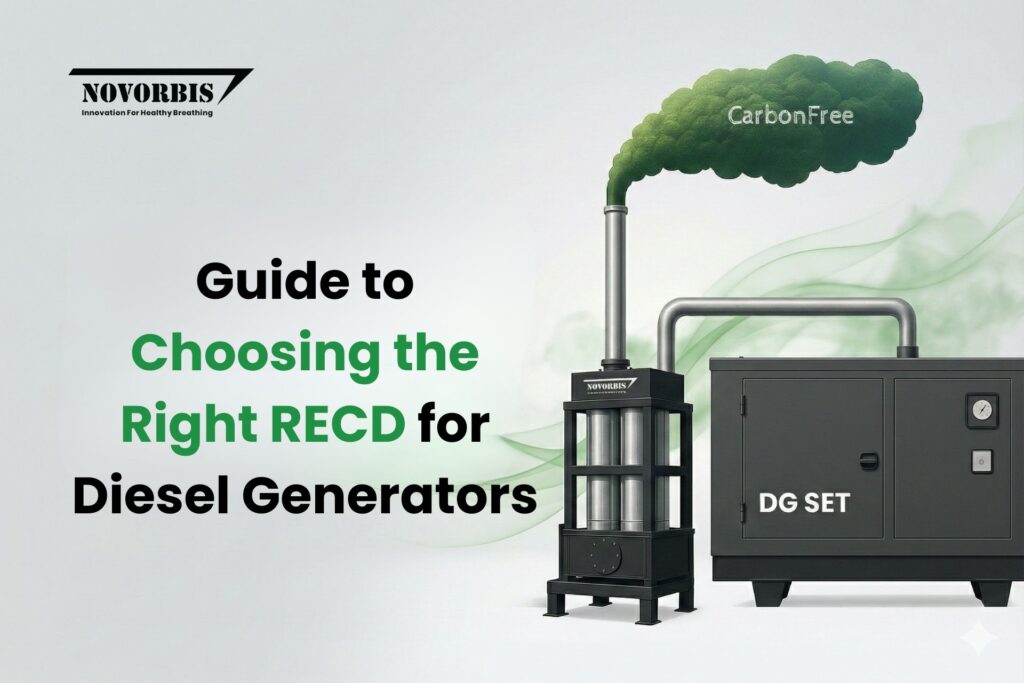
Let’s be honest. For decades, the diesel generator (DG) set has been the unsung hero of Indian industry, healthcare, and infrastructure. When the grid goes down, that familiar, deep rumble is the sound of business continuity. It’s the sound of lights staying on, data being saved, and critical operations running without a hitch.
But there’s another side to that coin. We’ve all seen it: the puff of black smoke, the acrid smell, the layer of soot. In a country grappling with air quality challenges, the emissions from these powerful machines have, rightly, come under serious scrutiny.
The government, led by the Central Pollution Control Board (CPCB), has laid down new rules. And if you own or operate a diesel generator, this isn’t just “another regulation.” It’s a fundamental shift in how we produce backup power.
The answer to this challenge? A four-letter acronym you’re going to be hearing a lot about: RECD.
This guide is for you—the facility manager, the business owner, the operations head—who needs to understand what an RECD is, why you suddenly need one, and how to choose the right one without making a costly mistake.
First Off, what exactly is an RECD?
RECD stands for Retrofit Emission Control Device.
Let’s break that down.
- “Retrofit” means it’s designed to be added after the fact to your existing, or “in-use,” diesel generator.
- “Emission Control” is its job: to clean the exhaust before it hits the atmosphere.
Think of it as a high-tech purifier for your generator’s exhaust pipe. Its sole purpose is to capture the harmful pollutants—especially Particulate Matter (PM) or “soot”—that your DG set produces, turning that visible black smoke into a much cleaner, compliant, and breathable emission.
It’s the bridge between your reliable, older generator and India’s new, cleaner air standards.
Why India Needs RECDs Right Now
This isn’t just a “nice to have” upgrade. It’s rapidly becoming a non-negotiable requirement. Here’s the 30,000-foot view of why this is all happening so fast.
1. The CPCB and NGT Mandates
The National Green Tribunal (NGT) and the Central Pollution Control Board (CPCB) are the primary drivers. Following the implementation of new Diesel Generator Emission Norms (like CPCB IV+ for new generators), the focus has shifted to the massive existing fleet.
The NCAP (National Clean Air Programme) and various NGT orders have mandated that “in-use” DG sets must be cleaned up. The directive is clear: install an RECD that can reduce Particulate Matter (PM) emissions by at least 70%.
2. The Business Case for Compliance
Non-compliance is no longer a viable option. State Pollution Control Boards (SPCBs) are actively enforcing these rules, especially in non-attainment cities and the NCR.
The risks are simple and severe:
- Hefty Fines: Financial penalties that can wipe out any “savings” from not upgrading.
- Operational Shutdown: The authorities have the power to seal non-compliant DG sets, potentially shutting down your entire operation.
- Brand Damage: In today’s eco-conscious market, being known as a polluter is bad for business.
3. It’s About More Than Just Rules
Here’s a more reflective thought: we all live and work here. We breathe the same air. Reducing the thick, toxic smoke from our backup power systems is a tangible way to contribute to a healthier environment for our employees, our customers, and our communities. It’s a move from a reactive cost to a proactive responsibility.
How to Choose the Right RECD: A 5-Point Checklist
Okay, so you’re convinced you need one. The problem is, the market is suddenly flooded with options. How do you separate the robust solutions from the ones that will fail in six months?
Here’s where it gets interesting. Not all RECDs are created equal. Use this checklist to ask the right questions.
1. Is it CPCB Approved? (The Non-Negotiable)
This is the first and most important question. Any CPCB RECD in India must be approved by the CPCB and tested by one of its designated agencies, like the Automotive Research Association of India (ARAI) or the International Centre for Automotive Technology (ICAT).
Pro-Tip: Ask the vendor for their CPCB Type Approval Certificate. Don’t just take their word for it. Check that the certificate is valid and covers the specific kVA range of your generator.
2. What’s the Actual Reduction Efficiency?
The CPCB mandates a minimum of 70% PM reduction. But many leading technologies, designed to be future-proof, can achieve much more. Aiming for a higher reduction (e.g., 90%+) ensures you’ll remain compliant even if the norms get stricter.
3. Does it Use a Filter or is it Filter-Less?
This is a critical, and often overlooked, technical detail.
- Filter-Based (e.g., DPF): These are common. They work like a physical net, trapping soot in a (usually ceramic) filter. The catch? This filter clogs. It then needs to be cleaned, either by a high-heat “regeneration” process (which uses more fuel) or by manual, costly, and messy removal and cleaning.
- Filter-Less (e.g., Electrostatic, Plasma): These modern systems use a different principle. They charge the particles and collect them on plates, or they use a plasma field to oxidize (burn) the soot. They don’t have a physical filter that clogs, which can drastically reduce maintenance and downtime.
4. What About Backpressure?
This is the silent killer of generator engines. An RECD, by its very nature, adds a component to the exhaust line. If it’s poorly designed, it creates “backpressure,” which is like forcing the engine to exhale through a tiny straw.
Excessive backpressure leads to:
- Increased fuel consumption
- Lower power output
- Engine overheating
- In severe cases, permanent engine damage
You must choose an RECD that is certified to operate at very low backpressure, well within your engine manufacturer’s limits.
5. What’s the Total Cost of Ownership (TCO)?
Don’t just look at the upfront RECD cost. A cheap unit with a filter that needs replacing every 500 hours will cost you a fortune in the long run.
Ask about:
- Maintenance: How often does it need to be cleaned? Can my team do it, or does it require a specialist?
- Consumables: Does it have filters or chemicals that need to be replaced?
- Downtime: How long does maintenance take?
A slightly more expensive filter-less system might have a TCO that is 50% lower over five years.
Spotlight: The Novorbis Itus CarbonFree™ RECD
Now that you know what to look for, I want to show you an example of a technology that was built to solve these specific challenges. The CarbonFree RECD from the innovators at Novorbis Itus is a product of true Indian engineering, designed for tough Indian conditions.
It directly addresses every point on our checklist, which is why it’s gaining so much attention.
1. It’s Filter-Less (No Clogging, No Fuss)
This is its biggest USP. The CarbonFree™ RECD doesn’t use a DPF (Diesel Particulate Filter). Instead, it uses a high-efficiency plasma-based system to oxidize the soot particles as they pass through.
What does this mean for you?
- No Clogging: It literally can’t clog.
- Minimal Maintenance: No filters to clean, no filters to replace.
- Consistent Performance: It works at peak efficiency 24/7, not just when the filter is clean.
2. It Achieves Over 90% Emission Reduction
While the mandate is 70%, the CarbonFree™ system consistently delivers over 90% PM reduction. This isn’t just compliant; it’s exemplary. It’s a solution that positions your business as a leader in environmental responsibility.
3. It’s Designed for Ultra-Low Backpressure
The plasma system is an open, flow-through design. It doesn’t obstruct the exhaust path like a dense filter. This means the backpressure it creates is negligible, protecting your generator’s engine, preserving its fuel efficiency, and extending its life.
4. It’s Built for India
This isn’t a European design that’s been awkwardly adapted. It was engineered in India, for India. It’s built to be robust, handle variable fuel quality, and operate reliably in the heat, dust, and humidity that our generators live in. That’s the kind of innovation that actually makes sense in our conditions.
A Practical 4-Step Guide to Buying and Installation
Ready to make the move? Here’s the process, simplified.
Step 1: The Site Survey & DG Set Audit
Before you buy anything, you need an expert to look at your setup. A proper RECD installation partner will assess:
- Your DG Set: kVA rating, make, model, engine phase (Phase I or II), and year of manufacture.
- Your Space: The physical layout of your DG room, exhaust piping, and available space.
- Your Usage: How often do you run your generator? For how long?
Step 2: Choosing the Right Model
Based on the audit, the vendor (like Novorbis Itus) will recommend a specific RECD model that is CPCB-certified for your exact generator type. This is not a one-size-fits-all product.
Step 3: Professional Installation
The RECD unit is integrated into your existing exhaust pipeline. This is a job for trained technicians. They will cut, weld, and fit the device, ensuring all connections are secure and leak-proof.
Step 4: Post-Installation Checks & Certification
This is the most important part. After installation, the team should perform:
- A smoke test to visibly show the difference.
- A backpressure check to prove it’s within safe limits.
- An emission test (using a portable analyzer) to confirm the PM reduction.
You will then be given the final compliance certificate, which is your “proof” for the SPCB.
Common Mistakes to Avoid (Please Read This!)
I’ve seen people make these mistakes already. Learn from them.
- Mistake 1: Chasing the Cheapest Model. A cheap, filter-based RECD will feel like a victory for one day—until the first maintenance bill arrives. You’ll be reminded of your mistake every time your generator chokes on its own exhaust. Don’t do it. Focus on TCO.
- Mistake 2: Ignoring Your Engine Manufacturer. Always check with your DG set manufacturer or their authorized dealer. A poorly chosen RECD can, in some cases, void your engine’s warranty. A good RECD supplier (like Novorbis Itus) works with engine manufacturers to ensure full compatibility.
- Mistake 3: Believing “Fit and Forget.” Even the best filter-less system needs some basic checks. “Low maintenance” doesn’t mean “no maintenance.” Plan for a simple annual check-up, just as you do for the generator itself.
Frequently Asked Questions (FAQs)
- 1. Is installing an RECD mandatory for all DG sets in India? It is mandatory for all in-use DG sets (up to 800 kW) in areas covered by the NCAP and in regions specified by NGT/CPCB/SPCB orders, which now includes most major industrial and urban areas. The safe bet is to assume you will need one.
- 2. What is the typical RECD cost? The cost varies widely based on your generator’s kVA rating and the technology (filter-based vs. filter-less). A filter-less plasma system might have a higher initial cost but a much lower Total Cost of Ownership (TCO) due to zero filter replacement and minimal maintenance.
- 3. How long does the RECD installation take? A professional team can typically complete a standard installation in 6 to 8 hours. This is planned carefully to minimize downtime for your facility.
- 4. What’s the main difference between a filter-less RECD and a DPF? A DPF (Diesel Particulate Filter) traps soot. A filter-less plasma RECD destroys soot. Trapping leads to clogging and high maintenance. Destroying leads to continuous, low-maintenance operation.
- 5. Will the RECD increase my fuel consumption? A poorly designed, high-backpressure RECD absolutely will. A high-quality, ultra-low backpressure system like the CarbonFree™ RECD is designed to have a negligible impact on fuel consumption, preserving your generator’s efficiency.
The Future is Clearer (and Cleaner)
The age of “out of sight, out of mind” for diesel exhaust is over. This transition to RECDs is not just a regulatory hurdle; it’s a permanent and positive change.
Choosing the right RECD for your diesel generators in India is a decision that impacts your finances, your operations, and your reputation. It’s a chance to invest in a technology that protects your engine, your wallet, and the air we all share. That familiar rumble of the generator will still be the sound of reliability—it just won’t come with that cloud of black smoke anymore.
Ready to make your generator cleaner and fully compliant? Visit recd.novorbisitus.com and see how the filter-less CarbonFree™ technology can fit your setup.
What to Check When Choosing the Right RECD
When selecting an RECD for your diesel generator, here are key factors to evaluate. Use this as a checklist to compare vendors and models.
| Factor | Consideration | Why it matters |
| Certification & Approval | Look for CPCB type-approval, ARAI / ICAT certification, vendor listed on CPCB vendor list. Central Pollution Control Board+2ciimarketplace.in | Ensures the device has been tested and meets emission reduction standards. |
| Technology & Efficiency | What is the % reduction of PM, CO, HC, NOx? Is the device filter-less or filter-based? What is back-pressure? novorbisitus.com | Better technology means more efficient removal of pollutants and lower impact on DG performance. |
| Compatibility & Capacity Range | Does the device suit your DG set’s kVA/kW rating, exhaust geometry, silencer arrangement? Vendors should state a capacity range (e.g., 40 kVA to 1000 kVA). | A mismatch can lead to poor performance or installation headaches. |
| Installation & Back-pressure | How easily can it be retrofitted? What modifications are required? What is the additional exhaust back-pressure it introduces? Imimg | High back-pressure can impact engine life and performance. |
| Maintenance & Consumables | Does it require filters, frequent cleaning, chemicals, or active regeneration? Filter-less designs reduce consumables. novorbisitus.com | Lower maintenance and consumables mean lower operating cost and less downtime. |
| Service Network & Support | Does the vendor offer pan-India servicing, spare parts, warranty, AMC? | Ensures long-term reliability and reduces risk. |
| Cost and ROI | What is the upfront cost + installation? What are savings (fuel, maintenance, regulatory risk)? | You want the device to pay for itself or at least be justified by compliance and savings. |
| Space & Integration | How much space does the unit occupy? Does it fit in the existing exhaust & silencer arrangement? | Easy integration reduces installation cost and disruption. |
| Future-proofing & Scalability | Will the device meet future tighter norms? Is the vendor developing next-gen tech? | Avoid being locked into a solution that becomes obsolete. |