
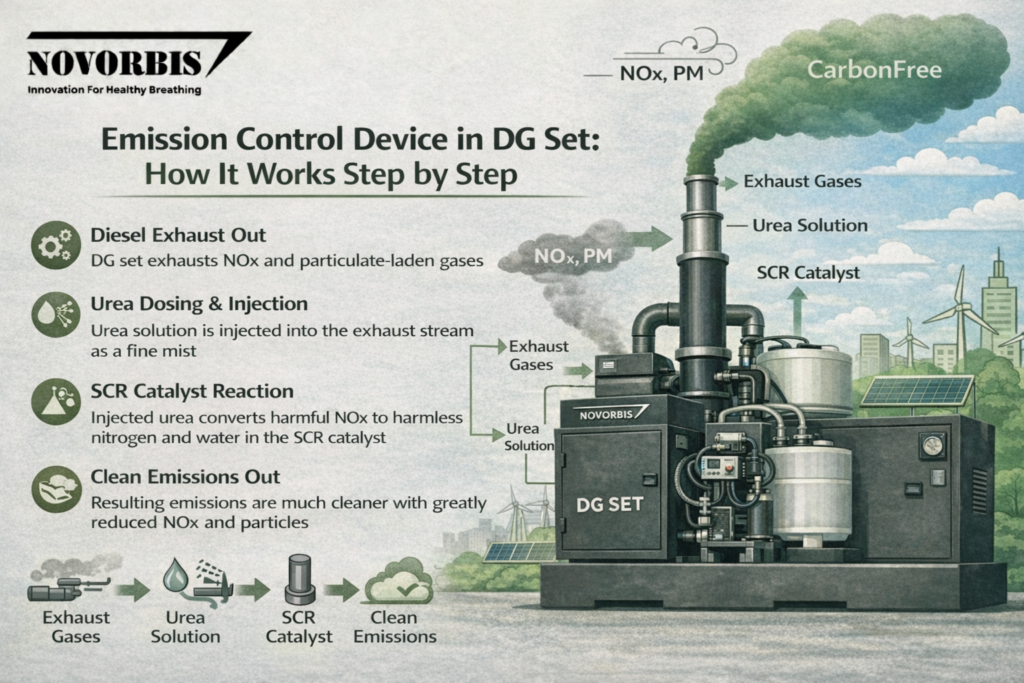
Diesel Generator (DG) sets are widely used for power backup, but they also release harmful smoke and gases into the air. To control this pollution, an Emission Control Device (ECD) is installed on the DG set exhaust.
In this guide, we explain how an emission control device works in a DG set—step by step, in very simple language.
What Is an Emission Control Device in a DG Set?
An Emission Control Device is a pollution-reduction system fitted to the exhaust of a diesel generator.
It helps DG sets meet emission norms set by authorities like the Central Pollution Control Board (CPCB) by reducing smoke and toxic gases.
Simply put: It cleans the DG set smoke before releasing it into the air.
Why Emission Control Devices Are Needed
When a DG set runs, it emits:
- Black smoke (particulate matter)
- Carbon monoxide (CO)
- Nitrogen oxides (NOx)
- Unburnt hydrocarbons (HC)
These pollutants harm health and the environment, which is why emission control devices are mandatory for many DG sets.
How Emission Control Device Works in DG Set (Step by Step)
Step 1: DG Set Starts Running
When the DG set is switched on, diesel fuel burns in the engine to produce power.
This combustion creates hot exhaust gases filled with smoke and pollutants.
Step 2: Exhaust Gas Enters the Emission Control Device
Instead of going directly into the air, the exhaust gases pass through the emission control device installed on the exhaust pipe.
Step 3: Trapping of Smoke Particles
Inside the device:
- Tiny dust and soot particles (PM) are trapped, filtered, or oxidized
- Black smoke is significantly reduced
(Filter-based systems trap particles; filterless systems burn or convert them.)
Step 4: Treatment of Harmful Gases
Next, toxic gases are treated:
- Carbon monoxide (CO) is converted into carbon dioxide (CO₂)
- Hydrocarbons (HC) are oxidized into harmless gases
- Nitrogen oxides (NOx) levels are reduced (depending on technology)
This process uses catalytic or oxidation technology.
Step 5: Temperature & Pressure Monitoring
Sensors inside the system monitor:
- Exhaust temperature
- Back pressure
This ensures safe operation and prevents engine damage.
Step 6: Cleaner Exhaust Is Released
After treatment, much cleaner exhaust gas is released into the atmosphere with:
- Less smoke
- Lower particulate matter
- Reduced toxic emissions
Types of Emission Control Devices Used in DG Sets
1. Filter-Based Device
- Uses physical filters
- Requires periodic cleaning
2. Filterless Device
- Uses advanced oxidation technology
- Low maintenance
3. Retrofit Emission Control Device (RECD)
- Installed on existing/old DG sets
- Most common solution in India
Benefits of Step-by-Step Emission Control
- Reduces black smoke visibly
- Improves air quality around the site
- Helps comply with CPCB norms
- Avoids fines and DG set shutdown
- Extends usable life of DG set
Simple Example
Think of an emission control device like a water purifier:
- Dirty water goes in
- Harmful impurities are removed
- Clean water comes out
Similarly:
- Dirty exhaust goes in
- Harmful pollutants are removed
- Cleaner air comes out
Conclusion
An Emission Control Device in a DG Set works by treating exhaust gases step by step—from trapping smoke particles to converting toxic gases—before releasing cleaner air into the environment.
It is an essential solution for pollution control, legal compliance, and responsible DG set operation.