
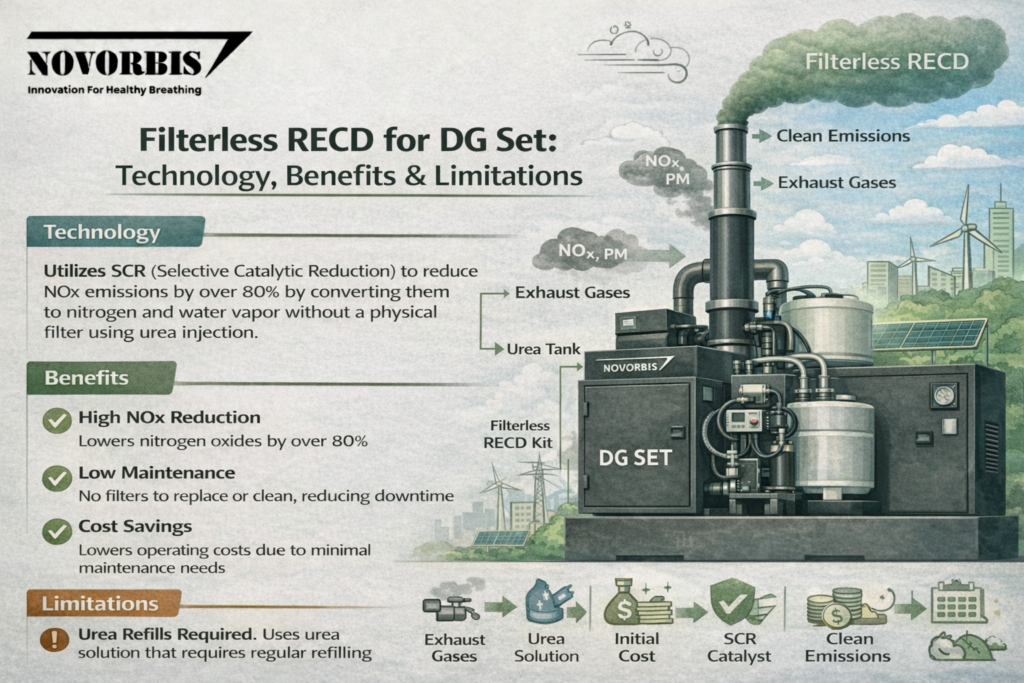

With stricter air-pollution norms in India, many DG set owners are now shifting from traditional filter-based systems to Filterless RECD solutions. A Filterless Retrofit Emission Control Device (RECD) is designed to reduce DG set emissions without using physical filters, making it a low-maintenance and efficient option.
This guide explains the technology, benefits, and limitations of filterless RECD for DG sets in simple language.
What Is a Filterless RECD for DG Set?
A Filterless RECD is an advanced emission control device installed on the exhaust of an existing diesel generator that reduces pollutants without trapping them in filters.
Instead of collecting soot in a filter, it uses oxidation and catalytic technology to treat exhaust gases and convert harmful emissions into less harmful ones—while complying with norms set by the Central Pollution Control Board (CPCB).
Filterless RECD cleans DG set smoke without clogging filters.
Technology Used in Filterless RECD
Filterless RECD systems typically use a combination of the following technologies:
1. Oxidation Technology
- Burns or oxidizes soot particles at high temperature
- Prevents particle accumulation
2. Catalytic Converter System
- Converts harmful gases like CO and HC into CO₂ and water vapor
- Reduces visible smoke
3. Flow-Optimized Exhaust Design
- Maintains low back pressure
- Protects DG engine performance
Because there are no physical filters, there is no choking or frequent cleaning required.
How Filterless RECD Works (Simple Steps)
- DG set exhaust enters the filterless RECD
- High temperature + catalyst oxidize smoke particles
- Toxic gases are chemically converted
- Cleaner exhaust is released into the air
This continuous process ensures stable emission reduction even during long DG operation.
Benefits of Filterless RECD for DG Set
✅ 1. Low Maintenance
- No filters to clean or replace
- Ideal for continuous or long-hour DG operation
✅ 2. No Clogging or Back Pressure
- Maintains smooth exhaust flow
- Protects engine health and fuel efficiency
✅ 3. Longer Service Life
- Fewer moving or consumable parts
- Suitable for industrial and commercial use
✅ 4. Compliance with CPCB Norms
- Approved filterless RECD systems meet emission limits
- Reduces risk of penalties or DG set sealing
✅ 5. Better Operational Reliability
- Performs consistently even under heavy load
Limitations of Filterless RECD
While filterless RECDs are highly efficient, they do have some limitations:
⚠️ 1. Higher Initial Cost
- Generally more expensive than basic filter-based systems
⚠️ 2. Temperature Dependency
- Works best when DG set operates at recommended load
- Very low load operation may reduce oxidation efficiency
⚠️ 3. Certification Is Critical
- Only CPCB-approved filterless RECD systems are acceptable
- Non-certified products may fail compliance checks
Filterless RECD vs Filter-Based RECD (Quick Comparison)
| Feature | Filterless RECD | Filter-Based RECD |
|---|---|---|
| Filters required | ❌ No | ✅ Yes |
| Maintenance | Very Low | Moderate to High |
| Clogging risk | Minimal | High |
| Operating cost | Low (long term) | Higher |
| Initial cost | Higher | Lower |
| Suitable for long runtime | Excellent | Limited |
Where Filterless RECD Is Best Used
Filterless RECD is ideal for:
- Industries & factories
- Hospitals
- Data centers
- Malls & commercial buildings
- Residential societies with frequent DG usage
Conclusion
A Filterless RECD for DG Set is a modern, efficient, and low-maintenance solution for reducing diesel generator emissions. By using oxidation and catalytic technology instead of physical filters, it offers longer life, better reliability, and smoother operation.
While the initial cost may be higher, the lower maintenance, better performance, and compliance reliability make filterless RECD a smart long-term investment for DG owners.