
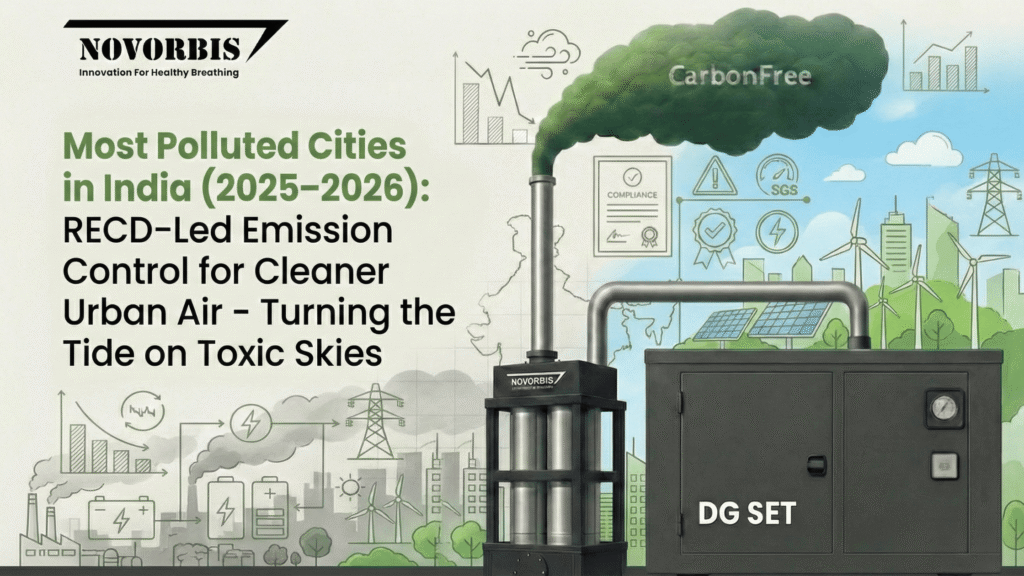
India’s Urban Air Emergency Enters a Critical Phase (2025–2026)
Air quality deterioration in India has now crossed from chronic concern to structural crisis. As we move through 2025–2026, India’s fastest-growing cities are facing a dangerous convergence of factors—industrial expansion, construction intensity, vehicle density, and persistent power instability. The result is sustained exposure to PM2.5 concentrations multiple times higher than global safety thresholds.
Consolidated assessments aligned with global air-quality benchmarking (including IQAir-style methodologies) continue to place Indian cities disproportionately high in global pollution rankings. The uncomfortable truth is this: incremental fixes are no longer enough.
This article—Most Polluted Cities in India (2025–2026): RECD-Led Emission Control for Cleaner Urban Air—provides:
- A clear ranking of India’s most polluted urban centers
- An explanation of why diesel generators have become a pollution multiplier
- A decisive, immediately deployable solution: Retrofit Emission Control Devices (RECDs)
Cleaner air is no longer aspirational. In 2025–2026, it is an engineering, compliance, and governance imperative.
India’s PM2.5 Crisis (2025–2026): When “Above Limits” Becomes the Norm
PM2.5—fine particulate matter smaller than 2.5 microns—remains the most dangerous pollutant in India’s urban air. These particles penetrate deep into lung tissue, enter the bloodstream, and accelerate respiratory, cardiovascular, and metabolic disease.
- WHO annual guideline: 5 µg/m³
- Urban India (average): 10–25× higher
- Pollution peaks (winter & outage periods): far beyond annual means
This is not episodic pollution—it is continuous exposure.
Top Most Polluted Cities in India by Annual PM2.5 (2025–2026)
| Rank | City | State | Avg PM2.5 (µg/m³) |
| 1 | Byrnihat | Meghalaya | 130+ |
| 2 | Delhi | Delhi (UT) | 110+ |
| 3 | Mullanpur | Punjab | 103+ |
| 4 | Faridabad | Haryana | 102+ |
| 5 | Loni | Uttar Pradesh | 92+ |
| 6 | New Delhi | Delhi (UT) | 92+ |
| 7 | Gurugram | Haryana | 88+ |
| 8 | Ganganagar | Rajasthan | 87+ |
| 9 | Greater Noida | Uttar Pradesh | 84+ |
| 10 | Bhiwadi | Rajasthan | 83+ |
Key takeaway:
These are not isolated spikes—they represent persistent emission loading, much of it driven by localized, poorly controlled diesel exhaust.
Diesel Generators (DG Sets): The Silent Urban Pollution Multiplier
India’s unreliable grid makes diesel generators unavoidable. Hospitals, IT parks, residential societies, malls, factories, and data centers depend on DG sets daily—not occasionally.
Why DG Sets Are So Harmful in Cities
Unlike power plants (often outside city limits), DG sets:
- Operate inside dense neighborhoods
- Emit pollution at breathing height
- Run intensively during peak pollution seasons
- Frequently lack advanced after-treatment
Major Pollutants from DG Sets
- PM2.5 & PM10 – soot, black carbon, ultrafine particles
- NOx – smog and ground-level ozone formation
- CO – toxic, oxygen-blocking gas
- Unburnt hydrocarbons – secondary aerosol formation
In high-density zones, a single uncontrolled DG set can undo the benefit of dozens of electric vehicles.
Retrofit Emission Control Devices (RECDs): The Fastest Path to Clean Backup Power
RECDs are advanced exhaust after-treatment systems designed specifically to retrofit existing diesel generators—without modifying the engine core.
In simple terms:
You keep your generator. You eliminate most of its pollution.
How RECD Technology Works (Simplified)
- Diesel Oxidation Catalyst (DOC)
Converts CO and hydrocarbons into safer compounds - Diesel Particulate Filter (DPF)
Traps and oxidizes soot and PM2.5 - Selective Catalytic Reduction (SCR)
Converts NOx into nitrogen and water vapor
Typical Emission Reduction Performance
- PM reduction: 70–90%
- NOx reduction: up to 90%
- CO & HC reduction: significant and consistent
This is engineering certainty, not theoretical promise.
Why RECDs Are Critical in India’s Most Polluted Cities (2025–2026)
Delhi NCR (Delhi, Gurugram, Faridabad, Noida, Loni, Bhiwadi)
- High DG density + severe winter inversions
- Emergency GRAP restrictions increasing
- RECDs enable continued operation without violations
Punjab Industrial Belt (Mullanpur & surroundings)
- Cluster-based DG usage
- RECDs prevent forced shutdowns during inspections
- Supports uninterrupted industrial output
Byrnihat (Meghalaya)
- Rapid industrialization in fragile terrain
- RECDs deliver immediate particulate control where dispersion is limited
Rajasthan & Western UP Cities
- Industrial + agricultural DG dependence
- Scalable RECD deployment suits dispersed installations
Regulatory Landscape (2025–2026): Why Waiting Is Risky
India’s Central Pollution Control Board (CPCB) has intensified enforcement across the 19 kW–800 kW DG category.
RECDs are now widely recognized as compliance-enabling infrastructure, not optional upgrades.
Advantages of Early Adoption
- Protection from emergency shutdown orders
- Reduced inspection friction
- Eligibility for state-level sustainability incentives
- Strong ESG and CSR positioning
In 2025–2026, non-compliance is no longer overlooked—it is penalized.
Economic, Environmental & Social ROI of RECD Installation
| Dimension | Benefit |
| Compliance | CPCB-aligned emission control |
| Public Health | Reduced respiratory & cardiac risk |
| Operations | Zero compromise on backup reliability |
| Financial | Avoided penalties, lower downtime |
| ESG | Measurable sustainability impact |
| Urban Impact | Localized PM2.5 suppression |
This is pollution control that pays for itself.
Recommended Emission Control Architecture
Conceptual Flow
Diesel Generator
→ Diesel Oxidation Catalyst
→ Diesel Particulate Filter
→ Selective Catalytic Reduction
→ Clean, compliant exhaust
Simple pathway. Massive impact.
Strategic Conclusion: 2025–2026 Is the Turning Point
India’s most polluted cities don’t lack power solutions—they lack clean power strategies.
Diesel generators will remain essential for resilience, but their emissions are no longer inevitable. RECDs transform legacy DG infrastructure into future-ready, regulation-compliant systems—without disrupting operations.
For hospitals, IT parks, factories, commercial complexes, and residential communities, RECD installation is no longer a choice—it’s a strategic safeguard.
Most Polluted Cities in India (2025–2026): RECD-Led Emission Control for Cleaner Urban Air is not just an article—it’s a roadmap for cities that refuse to normalize toxic skies.
Frequently Asked Questions
What is an RECD?
A Retrofit Emission Control Device—an exhaust after-treatment system for diesel generators.
Which pollutants do RECDs control best?
PM2.5, PM10, NOx, CO, and hydrocarbons.
Can RECDs be installed on existing DG sets?
Yes. They are purpose-built for retrofitting.
Are RECDs mandatory in India now?
Strongly enforced in high-pollution regions, especially NCR and industrial clusters.
What emission reduction is realistic?
Typically 70–90% reduction in PM and NOx with properly engineered systems.