
The Problem You Already Know About
Picture this: Your factory starts its day with the familiar rumble of a diesel generator (DG set) kicking to life. Within seconds, a thick plume of black smoke billows out of the exhaust—the kind you’ve probably seen a thousand times. You don’t really think about it. It’s just “that smoke from the generator,” right?
Well, here’s the thing: That black smoke isn’t just unsightly. It’s a mix of harmful pollutants called Particulate Matter (PM)—fine black soot that settles in the air, damages lungs, and pollutes your surroundings.
But that’s changing fast.
India is facing a serious air quality crisis. According to the National Clean Air Programme (NCAP), diesel generators contribute 18% of air pollution in cities. DG sets in industrial areas can emit soot at 11 times the manufacturer standards as they age.
So, the government acted. The National Green Tribunal (NGT) and Central Pollution Control Board (CPCB) have now mandated that generators above 125 kVA must have Retrofit Emission Control Devices (RECDs) installed. This is now a legal requirement—not just a suggestion.
This guide will break down what an RECD is, how it works, the main types, and why it’s a smart move for your business—in extremely simple English.
What is a Retrofit Emission Control Device (RECD)?
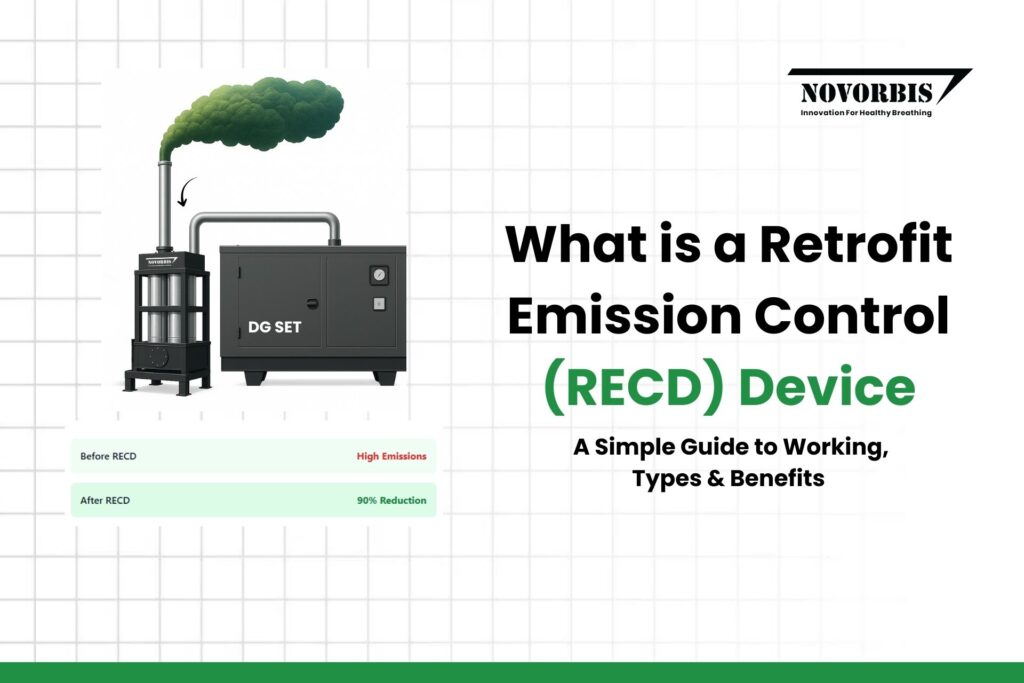
Think of an RECD as a high-tech air purifier for your generator’s exhaust.
Just as an air purifier cleans the indoor air by trapping dust and pollutants, an RECD cleans the dirty exhaust coming out of your generator before it enters the atmosphere.
Let’s break down the name:
- Retrofit means you’re adding it to an existing (in-use) generator. No need for a new generator.
- Emission Control means “cleaning” the harmful exhaust gases released.
- A device is a piece of hardware—usually a metal box—that sits in your exhaust pipeline.
An RECD is a pollution-control device you add to your generator to clean up the exhaust before it escapes into the air.
Its core job: It captures or destroys Particulate Matter (PM) (the visible black soot), plus other harmful gases like carbon monoxide, hydrocarbons, and nitrogen oxides. The goal: block at least 70% of these pollutants from reaching the atmosphere.
In simple terms—dirty exhaust goes in, much cleaner air comes out.
Why Do I Suddenly Need One in India?
The Problem
India hosts some of the most polluted cities in the world. Most DG sets are older models that simply weren’t built to control emissions. Studies show that DG sets over 10 years old can emit pollution levels 11 times worse than the original standards.
The NCAP estimates that 91% of DG sets in India have zero post-manufacture regulation—they just keep running and polluting.
The Mandate
To tackle this, the government stepped in. The Central Pollution Control Board (CPCB) set strict new standards. The National Green Tribunal (NGT) issued an order making RECD installation mandatory for in-use generators above 125 kVA—especially in cities failing to meet air quality standards (“non-attainment” cities).
The Bottom Line
It’s the law. Not having an RECD means:
- Heavy fines (lakhs of rupees)
- Operational shutdowns (generator sealed)
- Restricted operating hours
- Legal trouble
You need one because the law requires it—and enforcement is real.
How Does an RECD Actually Work? (The Simple Version)
Imagine your generator’s exhaust smoke as a crowd of people leaving a stadium. The RECD is like a high-tech security gate at the exit.
How it works:
- Exhaust enters – The dirty, smoky exhaust is forced into the RECD unit.
- Pollution gets “caught” or “destroyed” – Inside, technology either traps soot particles or destroys them.
- Clean air comes out – What leaves the chimney is dramatically cleaner.
The goal: Remove at least 70% of Particulate Matter (PM)—the black soot.
What Are the Main Types of RECDs?
Type 1: Filter-Based RECDs (Diesel Particulate Filters or DPFs)
How it works: Like a vacuum cleaner bag, exhaust is forced through a fine mesh that traps soot. Gases pass through; soot stays behind.
Pros:
- Can trap over 90% of particulate matter
- Proven technology
Cons:
- The filter clogs up over time (backpressure), needs cleaning (“regeneration” or manual cleaning)
- Maintenance and downtime required
Type 2: Filter-Less RECDs (Plasma, Electrostatic, or Oxidation Catalysts)
How it works: Instead of trapping soot, these devices destroy it using electrical fields (plasma), catalysts, or chemical reactions.
Pros:
- No filter to clog—much less maintenance, no downtime, no backpressure
- Better for engine health, longer generator life
Cons:
- Often a higher upfront investment (but can have lower total cost over time)
Quick Comparison Table:
| Aspect | Filter-Based (DPF) | Filter-Less (Plasma/Catalyst) |
| Soot Capture | 90%+ effective | 70-90% effective |
| Maintenance Frequency | High | Very low |
| Downtime Required | Yes | No |
| Backpressure Issues | Yes | No |
| Upfront Cost | Lower | Higher |
| 5-Year Total Cost | Often higher | Often lower |
| Best For | Intermittent use | Continuous use |
What Are the Real Benefits of Installing an RECD?
- CPCB Compliance: You’re legally compliant, avoiding massive fines and shutdowns.
- Drastically Cleaner Air: Visible reduction in black smoke—good for public health and the environment.
- Better Brand Image: Shows responsibility to customers, investors, and your community.
- Improved Employee Health: Cleaner air on-site for staff working near the generator.
- Protects Your Generator: A good, low-backpressure RECD protects engine life (filter-less models); a bad, clogging one can harm it.
Real-World Example: Why This Matters in India Right Now
You run a mid-sized factory in Indore. Your 250 kVA DG set runs daily.
In October 2024, the Pollution Control Board notifies: “Install an RECD by December or pay ₹50,000/month fine and risk shutdown.”
You can ignore it (bad move), install any RECD without research (risky), or research and install a smart, low-maintenance RECD—and safeguard both compliance and your business.
Conclusion:
RECD Is No Longer “If,” But “When” and “Which Kind”
An RECD isn’t just another box—it’s the high-tech purifier for your generator’s exhaust.
- What: A device that traps or destroys 70-90% of generator pollutants
- Why: Because clean air laws are now strictly enforced by CPCB/NGT
- How: Dirty exhaust goes in, clean air comes out via filters or catalysts
- Types: Choose wisely—filter-based for low-use, filter-less for continuous use
- Benefits: Compliance, cleaner air, brand trust, health, and engine protection
Choosing an RECD is now a matter of “when and which type”—understanding how they work is the first step to making a smart, compliant choice for your business.