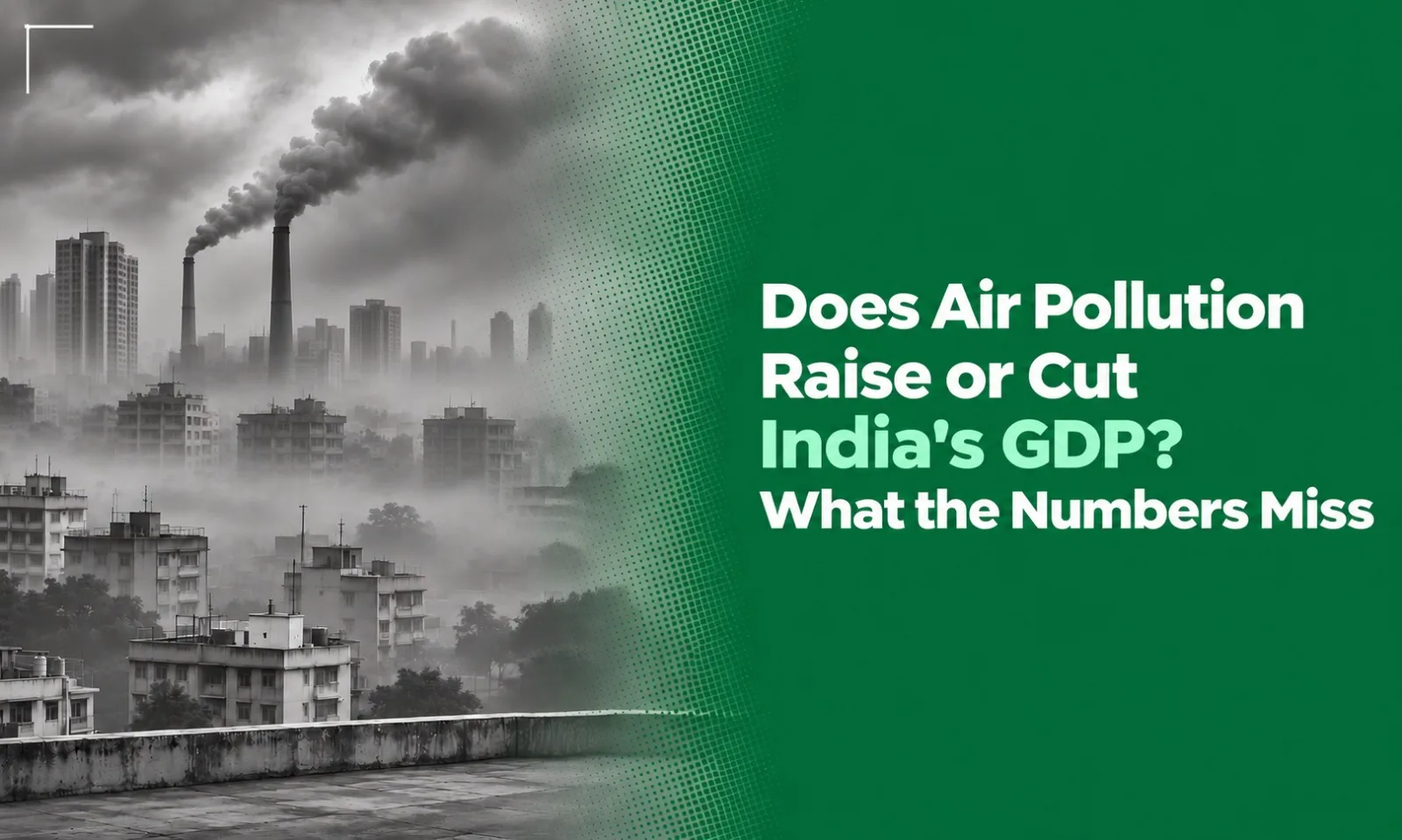
The air pollution cost to India GDP has moved from an environmental talking point to a mainstream debate. When Hotmail co-founder Sabeer Bhatia asked what the point of being the world’s fourth-largest economy is if the air is unbreathable and the water undrinkable, the question spread far beyond the usual policy audience. A sharper version has been circulating online: if people spend more on purifiers, bottled water and hospital visits, does pollution actually raise GDP? The honest answer has two halves, and both matter to anyone who runs a plant, a building or a generator.
Why GDP can rise while daily life gets harder
GDP measures market output, which in practice means spending. It does not ask whether that spending improves anyone’s life. Economists call the relevant category defensive expenditure: money spent to cope with a problem rather than to enjoy a benefit. As one standard teaching summary puts it, when air pollution worsens, people spend more on purifiers and medical treatment, GDP rises because that spending is counted as output, and well-being falls because people are paying to offset something that is making them worse off. The damage itself is invisible to the accounts. The same logic applies to cleanup after an oil spill, or to bottled water bought because the tap cannot be trusted. Textbooks sometimes compare it to digging a hole, filling it in again and calling it productive work.
None of this means pollution causes growth. It means the headline number cannot tell a healthy rise from a defensive one. Alternative measures such as green accounting subtract environmental damage, but they are not standard government metrics, so the debate keeps returning to the same blind spot.
What the evidence says about the net cost
The more useful question is whether the lost output outweighs the spending, and the studies that exist say it does. A 2019 Global Burden of Disease analysis published in The Lancet Planetary Health in 2021 estimated that lost output from premature deaths and illness linked to air pollution was equivalent to about 1.36% of India’s GDP in 2019, with a crude healthcare cost estimate of about 0.44%. A separate 2021 analysis by Dalberg Advisers with the Clean Air Fund and the Confederation of Indian Industry put the annual cost to Indian businesses at around 3% of GDP. The methods differ, so the numbers are not interchangeable, but both point the same way. Exposure is also widespread: one report puts roughly 46% of the population in areas where PM2.5 exceeds the 40 microgram per cubic metre limit.
So the fair reading is that pollution-related spending is counted as activity, while pollution-related losses reduce the economy underneath it. Net, the evidence leans negative.
Spending on control counts too, but it acts differently
There is an honest wrinkle. Pollution-control spending also enters GDP. An economics essay on green accounting notes that environmental control expenditure, such as utility scrubbers, shows up in the accounts and amounts to about 2% of GDP in the United States. A retrofit emission device bought by a factory counts as output just like a purifier bought by a household. The difference is where the money acts. A purifier protects one room after the emissions have happened. A control device reduces what leaves the exhaust in the first place. Under the CPCB procedure, a certified RECD must deliver at least 70% particulate reduction.
Where industry can act, with Delhi as the example
Vehicles, construction dust, crop burning and industry all feed urban air pollution, and no single source explains it. Diesel generators are one controllable source among them, which is why regulators have focused on them. In the Delhi-NCR, CAQM’s schedule asks DG sets from 41 kW to below 800 kW to run on dual fuel or carry a certified RECD, and non-compliant sets have been sealed, with the board directed to levy environmental compensation. State boards in Maharashtra, Karnataka and Gujarat have issued their own circulars. Our guides on which DG sets need RECD, by age and state, and on the SPCB inspection checklist explain the rules and the paperwork.
A fair reading of the debate
Critics point to gaps in enforcement and governance, and they argue that growth statistics hide daily hardship. Others note that regulators are acting, that mandates for DG set controls and other measures are now being enforced, and that improvement takes time. Both sides agree on one thing: if GDP is the headline scorecard, it needs context. That is a point about measurement, not blame, and it is the most useful way for a business to join the conversation.
What it means for a plant manager
Treat the debate as a prompt to check your own exposure. List every DG set and boiler, confirm which rules apply in your state, and compare the cost of a compliant retrofit with the cost of non-compliance, which can include sealing and compensation. A documented, certified solution is cheaper than an unplanned shutdown.
Frequently Asked Questions
Does pollution increase GDP?
Spending on purifiers, treatment and cleanup is counted as output, but studies estimate that pollution reduces output by more than that, so the net effect is negative.
How much does air pollution cost India?
Estimates range from about 1.36% of GDP in lost output to about 3% including business costs, depending on the method.
Want to know where your site stands?
Novorbis Itus is on the CPCB RECD vendor list (as of 30-06-2026). Share your DG set details and we will confirm what applies and what a compliant retrofit looks like.