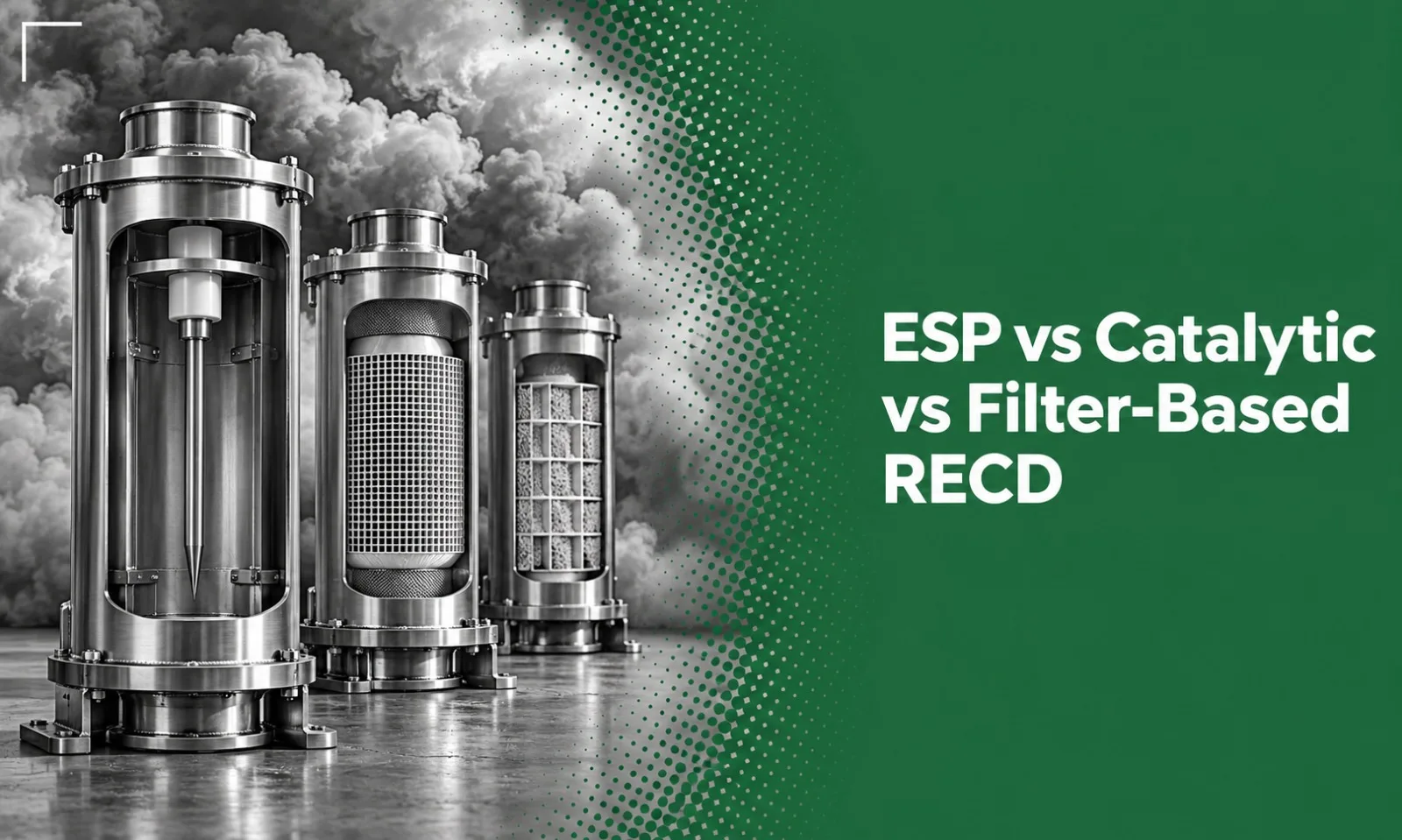
ESP vs catalytic vs filter-based RECD is an important comparison when choosing an emission control system for a diesel generator. These technologies differ in how they treat exhaust, control particulate matter and handle maintenance. This guide explains their working principles, advantages and limitations to help you assess a suitable retrofit emission control device for your DG set.
The right choice depends on your generator’s operating conditions, the pollutants you need to control and the certified performance of the specific device.
One distinction matters from the start: ESP, catalytic and filter-based systems are not always separate categories. A diesel particulate filter can use a catalytic coating, and an RECD may combine multiple treatment stages.
This guide explains the differences and the questions to ask before selecting an RECD for your DG set.
What Is an RECD for a Diesel Generator?
An RECD is an emission-control system fitted to an existing engine’s exhaust to reduce specified pollutants. Diesel exhaust after-treatment technologies include diesel particulate filters and diesel oxidation catalysts. Successful retrofitting requires a properly maintained engine and a device suited to its application.
Before comparing technologies, identify the emission you need to address:
Particulate matter (PM): Airborne particles, including soot.
Carbon monoxide (CO): A gaseous pollutant associated with incomplete combustion.
Hydrocarbons (HC): Unburned or partially burned fuel-related compounds.
Nitrogen oxides (NOx): A separate pollutant group requiring appropriate control technology.
A device’s ability to reduce one pollutant does not establish its effectiveness against all the others.
What Is an ESP-Based RECD?
An electrostatic precipitator (ESP) uses an electrical field to charge particles in an exhaust stream. These particles move towards collection surfaces, where they accumulate for removal.
Its primary function is particle collection. The condition of the electrodes and collection surfaces, electrical operation and particle characteristics affect performance.
Potential advantages
ESP technology can offer relatively low resistance to gas flow because particle collection does not depend on forcing the entire exhaust stream through a dense filter medium. However, actual backpressure depends on the complete installed system, including its housing and exhaust connections.
What to check
Ask the supplier to explain:
How collected soot is removed.
How frequently collection surfaces require cleaning.
What happens if the electrical system fails.
How performance is monitored.
Which engine range and operating conditions the certification covers.
An ESP collects particles; it does not automatically provide catalytic treatment of gaseous pollutants. If the product claims CO or HC reduction, ask which additional treatment stage delivers it.
What Is a Catalytic RECD?
“Catalytic RECD” is a broad description. The supplier should identify the actual catalyst and its purpose.
A common example is a diesel oxidation catalyst (DOC). Exhaust passes through a catalyst-coated structure that promotes chemical reactions, reducing carbon monoxide, hydrocarbons and part of the particulate matter associated with unburned fuel and oil.
However, a DOC has limited effect on solid elemental-carbon soot. EPA technical guidance reports typical PM reductions of 20–40% for the verified DOCs it describes. That range is background information, not a performance guarantee for an Indian DG-set product.
Potential advantages
A DOC can be useful where oxidation of CO and HC is part of the treatment objective. It may also form one stage of a combined emission-control system.
What to check
Catalytic performance depends on application conditions. Review exhaust temperature, fuel specifications, lubricating-oil consumption and engine compatibility with the supplier. These are recognised considerations in DOC selection.
Do not assume that every catalytic device is a particulate filter or a NOx-control system. DOC, catalysed DPF and selective catalytic reduction (SCR) describe different functions.
What Is a Filter-Based RECD?
A filter-based RECD captures particles in a filtration medium. A common example is a diesel particulate filter (DPF).
As soot accumulates, the filter needs a suitable regeneration strategy to oxidise the trapped soot. Regeneration may rely on normal exhaust conditions or an active system that supplies additional heat.
Ash is different from soot: it accumulates over time and requires periodic cleaning. Regeneration does not eliminate the need for ash maintenance.
Potential advantages
A DPF directly targets diesel particles through filtration. Some designs also incorporate catalytic functions.
What to check
Before choosing a filter-based RECD, establish:
Whether regeneration suits the generator’s actual duty cycle.
How differential pressure is monitored.
What alarms indicate soot loading or a fault.
How ash cleaning is performed.
What service downtime and replacement costs to expect.
The required regeneration strategy depends on the engine’s operating cycle. A system suitable for one application may need a different approach in another.
ESP vs Catalytic vs Filter-Based RECD: Comparison
The table below compares basic treatment mechanisms. Commercial products may combine them.
Selection factor | ESP-based system | Catalytic system: DOC example | Filter-based system: DPF example |
|---|---|---|---|
Working principle | Electrically charges and collects particles | Promotes chemical oxidation | Physically captures particles |
Main treatment role | Particulate collection | CO, HC and some organic PM reduction | Particulate filtration |
Soot handling | Collects soot on surfaces | Does not substantially capture solid soot by itself | Traps soot for regeneration |
Temperature consideration | Check the product’s operating envelope | Needs suitable conditions for catalyst activity | Needs a compatible regeneration strategy |
Backpressure consideration | Verify complete-system pressure loss | Verify installed pressure loss | Monitor pressure as the filter loads |
Maintenance focus | Collection surfaces and electrical components | Catalyst condition and engine health | Regeneration, ash cleaning and sensors |
Purchase evidence | Relevant certification and test results | Pollutant-specific test results | Relevant certification and regeneration suitability |
The practical conclusion is straightforward: compare complete systems under relevant operating conditions, rather than relying on technology labels alone.
Which RECD Is Best for Your DG Set?
There is no universal winner. Use the following process to narrow your options.
1. Establish your generator’s operating profile
Record the engine make, model, rated power, age, typical load and operating hours.
A standby generator running briefly during outages has a different operating profile from one supplying power for several hours daily. Ask the supplier to assess actual operation, including exhaust temperature where relevant.
2. Match the device to the required pollutant reduction
If particulate reduction is the main objective, ask for measured PM performance.
If the proposal also promises CO, HC or NOx reduction, request separate evidence for each pollutant. A soot-reduction claim should not be treated as proof of NOx control.
3. Verify certification and applicability
For Indian installations, distinguish between the CPCB testing framework, the specific product’s certification and the directions applicable to your site.
CPCB’s revised RECD testing procedure includes a 70% PM-reduction criterion within its specified testing framework, with durability-related adjustment. This should not be interpreted as a blanket statement that every DG set in India has identical retrofit obligations.
Before ordering, verify:
The certificate’s issuing agency and validity.
The exact device model.
The engine and power range covered.
Installation and operating conditions.
Applicable pollution-control-board directions for your location.
4. Confirm allowable exhaust backpressure
Request the generator manufacturer’s allowable exhaust-backpressure limit and the proposed system’s pressure-loss data.
For a filter-based system, also ask how the supplier manages increasing pressure as soot accumulates. EPA’s DPF installation guidance emphasises engine inspection, application suitability and correct installation before retrofitting.
5. Compare total ownership cost
The purchase price is only one part of the decision.
Request a written estimate covering installation, electrical requirements, cleaning, regeneration energy where applicable, consumables, replacement components, annual servicing and expected downtime.
This makes competing quotations easier to compare and exposes costs that may be missing from the initial proposal.
Common RECD Buying Mistakes
Choosing only by removal-efficiency claims
A percentage means little without the test method, pollutant measured, engine conditions and scope of certification.
Treating every catalytic device as a soot filter
A flow-through oxidation catalyst and a particulate filter perform different jobs. Ask for a diagram of the complete treatment system.
Assuming low visible smoke proves compliance
Visible smoke is not a substitute for the prescribed emissions test. Request the measurements required for your application.
Assuming “self-cleaning” means maintenance-free
Ask exactly what the system cleans automatically, what still requires servicing and what happens during a cleaning failure.
Installing an RECD on an unhealthy engine
Excessive oil consumption, poor combustion or mechanical faults should be investigated before installation. A retrofit device should be selected for a properly maintained engine.
Frequently Asked Questions
What is the difference between ESP and filter-based RECD?
An ESP uses electrical forces to collect particles on surfaces. A filter-based RECD captures particles in a filtration medium. Their soot-handling methods and maintenance needs differ.
Is a catalytic converter the same as a DPF?
No. A diesel oxidation catalyst promotes chemical reactions, while a DPF physically traps particles. A DPF can also have a catalytic coating, allowing both functions in one system.
Can an RECD reduce every diesel exhaust pollutant?
Do not assume so. Performance depends on the treatment stages installed. Check certified or verified results separately for PM, CO, HC and NOx.
Does a DPF require maintenance after regeneration?
Yes. Regeneration deals with accumulated soot, while ash requires periodic cleaning. Sensors and other system components also need attention according to the maintenance schedule.
Can an RECD be fitted to an existing diesel generator?
Retrofitting may be possible when the device is suitable for the engine, exhaust arrangement and operating conditions. Confirm technical compatibility and relevant certification before installation.
Which RECD has the lowest maintenance cost?
There is no reliable answer based only on the technology category. Compare written service schedules, component life, cleaning costs, energy use and downtime for the specific products.
Choose an RECD Using Evidence
ESP, catalytic and filter-based technologies offer different approaches to diesel exhaust treatment. Some commercial systems combine these approaches.
The most suitable RECD is the one that delivers the required pollutant reduction within your generator’s operating conditions, allowable backpressure and maintenance capacity.
Planning an RECD installation? Share your DG-set make, model, capacity, operating hours and location with the supplier. Request a compatibility assessment, relevant certification and a written maintenance proposal before choosing a system.
Talk to Novorbis about RECD for your DG set.