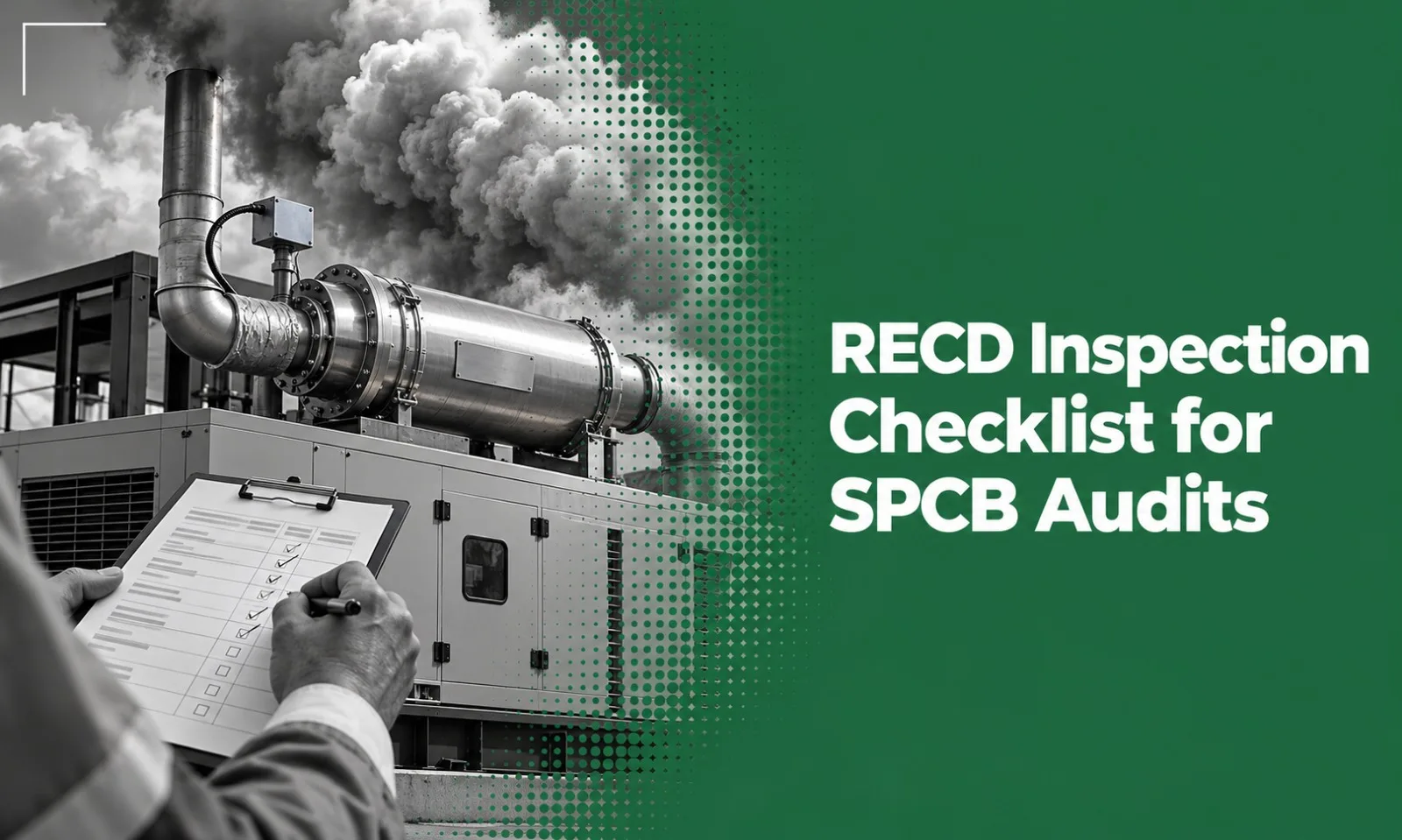
A good RECD inspection checklist starts from one idea: an inspector cannot see particulate matter leaving your exhaust pipe, so they look for paper and physical evidence that a certified device is fitted, working and maintained. When a State Pollution Control Board (SPCB) team, a CAQM flying squad or a consent-renewal officer visits a site with diesel generators, the visit is rarely about the generator alone. It is about whether you can prove, quickly and consistently, that each in-use DG set in scope has a compliant route behind it. This guide walks through what auditors typically ask for and how to have it ready before they arrive.
How audits of DG sets usually unfold
Audits come from three directions. Routine inspections happen when a board reviews your consent to operate, and a few boards also ask for periodic reports; Chhattisgarh's direction, for example, requires a half-yearly compliance report to the regional office. Complaint-driven visits follow a neighbour, resident or tribunal petition. In the Delhi-NCR, enforcement visits come from CAQM flying squads and the pollution control committees. Delhi's procedure treats a DG set user of 19 kW or more who is found non-compliant as liable for environmental compensation, and it expects the reply to be supported by documentary proof such as the purchase or installation order for an RECD from a CPCB-empanelled vendor.
That last point sets the tone. Auditors are practical. They want a short, organised file, not a pile of brochures, and they want the documents to agree with each other and with the machine standing in the plant room.
The documents to keep ready
Start with the identity of the DG set. The nameplate photographs should show the kVA and kW rating, the year of manufacture, the engine make and model and the emission phase, because every later document is judged against these numbers. A mismatch between the kW on the certificate and the kW on the nameplate is the most common reason a file is questioned.
Next comes the proof about the device. The RECD should carry a type approval certificate issued under the CPCB procedure by a recognised agency such as ARAI or ICAT, and that certificate should cover your engine's kW range and phase. Public tenders, for example, ask for exactly that type approval certificate from one of the CPCB-recognised test agencies. Under the CPCB procedure the device manufacturer must also repeat conformity-of-production testing every year, so it is sensible to ask the vendor for a currently valid conformity certificate. Add proof that the vendor is on the CPCB list. In Karnataka, advisers tell buyers to check the certification and test report rather than rely on the vendor's claim.
Then collect the installation evidence: the purchase order and invoice, the commissioning report with date and serial number, photographs of the device fitted to the exhaust line and any load-test record. Installation proof is what turns a purchase into compliance. If you chose the dual-fuel route instead, Delhi's procedure also refers to the dual-fuel kit and, where relevant, evidence of the gas supply line, so keep those with the file.
Performance and operating records come next. Keep the post-installation emission test report where your board asks for it, and a back-pressure reading if your OEM warranty depends on it. Add the running-hour log, the maintenance or AMC schedule and cleaning or service entries, because an inspector looking at a device with no service history will assume it is not being looked after. In Gujarat, advisers recommend keeping the RECD certification, vendor approval documents, dual-fuel records and emission test reports ready for both GPCB inspection and consent renewal review.
Finally, keep the regulatory filings: your consent to operate with its DG set conditions, any compliance report you have submitted, and acknowledgements from the board.
What the inspector checks on site
Item | What the inspector looks for | Where to keep it |
|---|---|---|
Nameplate | kW, year and phase match the certificate | Photo in the file; physical plate legible |
RECD certificate | Covers your kW range and engine phase | Folder at the plant office |
Vendor status | Listed on the CPCB RECD list | Dated printout |
Installation record | Date, serial number, signed commissioning | Folder and e-copy |
Test report | PM reduction result where asked | Folder |
Device on site | Fitted, no bypass, readable identification | Plant room |
Logs | Running hours, service and cleaning entries | Logbook at the genset |
Filings | Consent conditions and compliance reports | Compliance register |
Common reasons files fail
Three problems appear again and again. The first is a certificate that covers a different capacity range from the nameplate. The second is installation with no dated record, so nobody can show when the set became compliant. The third is paperwork that exists but is scattered across the purchase, maintenance and EHS teams, so nothing can be produced on the day. Inspectors tend to be generous with a clean file and unforgiving with a missing one, and in the NCR a non-compliant set can be sealed, with the board directed to levy environmental compensation.
How to prepare in a week
Spend day one photographing every nameplate and listing the sets. Spend day two matching each set to a certificate and its kW range. Use days three and four to gather installation and test records from the vendor. On day five, create one folder per set, with a one-page index. On day six, walk the plant room as an inspector would, and on day seven, fix what you find.
Special cases
Emergency-use sets, sets of 800 kW and above, dual-fuel conversions and new gensets that meet the CPCB IV+ norms each have their own documents and rules, so check your state circular and consent conditions rather than assuming the standard file applies. Our guides on which DG sets need RECD and on RECD vs a new CPCB IV+ genset explain how to tell which category you are in.
Need a file that stands up on audit day? Novorbis Itus is on the CPCB RECD vendor list (as of 30-06-2026). Share your DG set details and we will confirm what your file should contain.
Talk to Novorbis about RECD for your DG set.