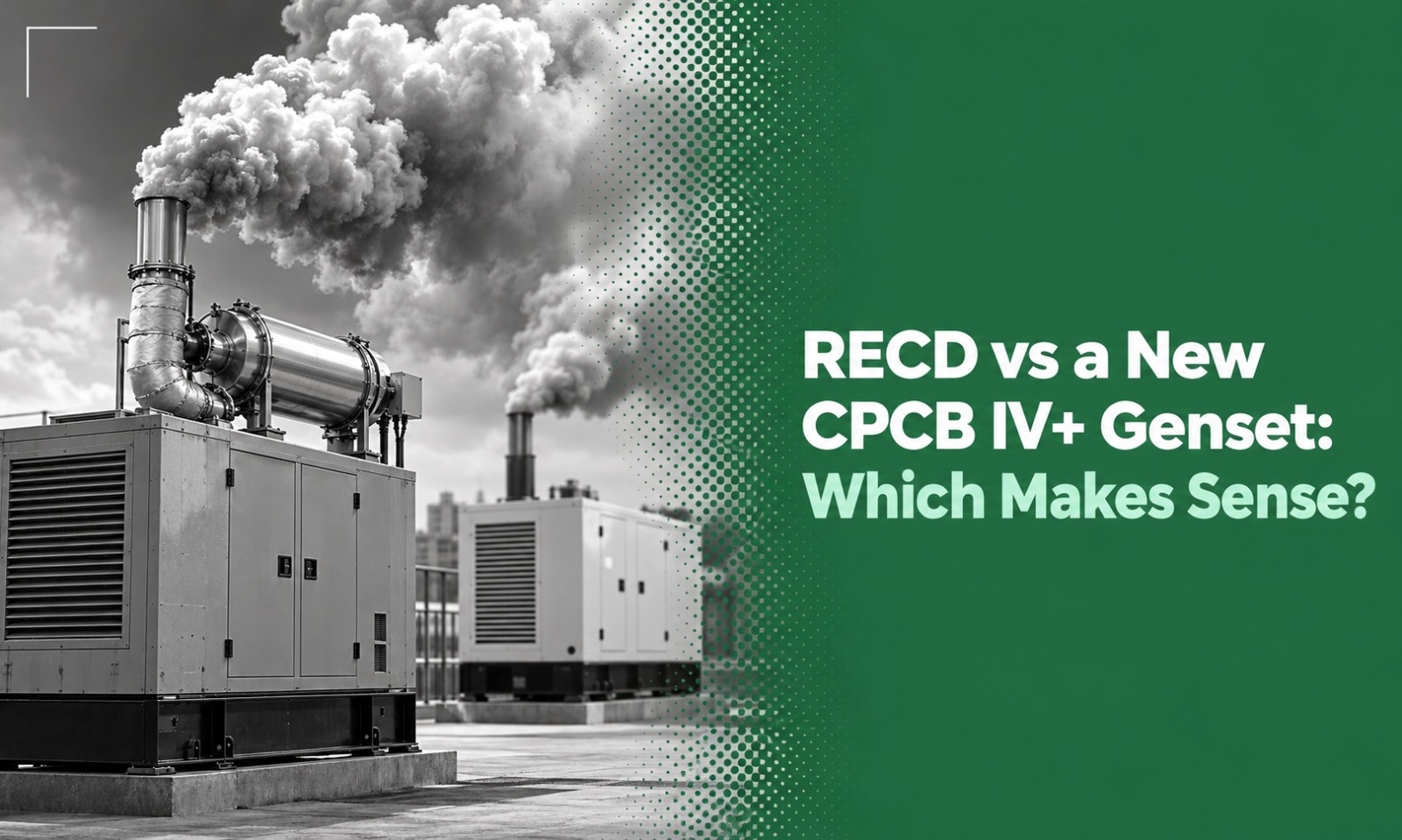
The RECD vs CPCB IV+ genset question comes up whenever a diesel generator has to meet emission rules: retrofit the set you have, or replace it with a new one? Both routes can work. The right choice depends on your engine's age, its condition and the cost of downtime. Here is how to decide.
At a glance
Upfront cost: a retrofit usually costs far less than a new genset.
Compliance: both routes can meet the rules if the RECD is from a CPCB-listed vendor.
When to replace: very old or unreliable engines may justify replacement.
What each option means
A retrofit emission control device (RECD) is fitted to the exhaust of your existing DG set. It must be certified under CPCB's procedure by an agency such as ARAI or ICAT, with at least 70% particulate matter reduction, and it applies to in-use sets up to 800 kW.
A CPCB IV+ genset is a new set whose engine meets the emission limits notified under GSR 804(E) dated 3 November 2022, with type approval from a certified agency.
Do both routes meet the rules?
For in-use sets up to 800 kW, CPCB has described three routes: fitting an RECD, using a dual-fuel system, or shifting to a genset that meets the GSR 804(E) norms. CAQM's schedule for the NCR also treats new gensets that meet these norms as a compliant category. State boards add their own deadlines and age rules, so check your circular.
Look beyond the price tag
A retrofit costs the device, installation and an AMC. A new genset adds the set itself, electrical and civil work, commissioning, disposal or resale of the old set and a longer outage. Compare the total cost over the years you expect to keep using the set, and get quotes for both routes.
Side by side
Factor | RECD retrofit | New CPCB IV+ genset |
|---|---|---|
Upfront cost | Lower | Higher |
Downtime | Usually short | Longer |
Compliance | Certified RECD from a CPCB-listed vendor | Type-approved CPCB IV+ engine |
Engine life | Keeps your engine's current age and condition | New engine, usually a fresh warranty |
Best for | Reliable sets with years of life left | Old, unreliable or wrongly sized sets |
When to retrofit and when to replace
Retrofit if your engine is reliable and well maintained, the set falls within the capacity on the RECD's certificate, and you need compliance quickly without a long outage. In some states, circulars cite 15 years from the date of manufacture as a limit.
Replace if breakdowns are frequent, parts are hard to find, the set is close to that age limit, its capacity no longer matches your load, or you were already planning an upgrade.
Five-step checklist
Note capacity in kW, year of manufacture and running hours.
Check your state board or CAQM circular for deadlines and age rules.
Review the set's repair history for the last two years.
Get quotes for both routes, including installation and downtime.
Choose the cheaper compliant route over the set's remaining life.
FAQs
Does a CPCB IV+ genset need an RECD?
Sets that already meet the CPCB IV+ norms are generally treated differently from older sets. Confirm with your state board.
Can I use dual-fuel instead?
Yes, it is a separate route that some boards recognise. Novorbis supplies RECDs, so check which route suits your site.
Will an RECD affect fuel use or warranty?
A certified, correctly sized RECD should keep fuel use close to normal. Read our guide on RECD fuel use and warranty.
Talk to Novorbis about RECD for your DG set. Novorbis Itus is on the CPCB RECD vendor list (as of 30-06-2026). Share your DG set's capacity, make and age, and we will confirm whether a retrofit makes sense.
Talk to Novorbis about RECD for your DG set.