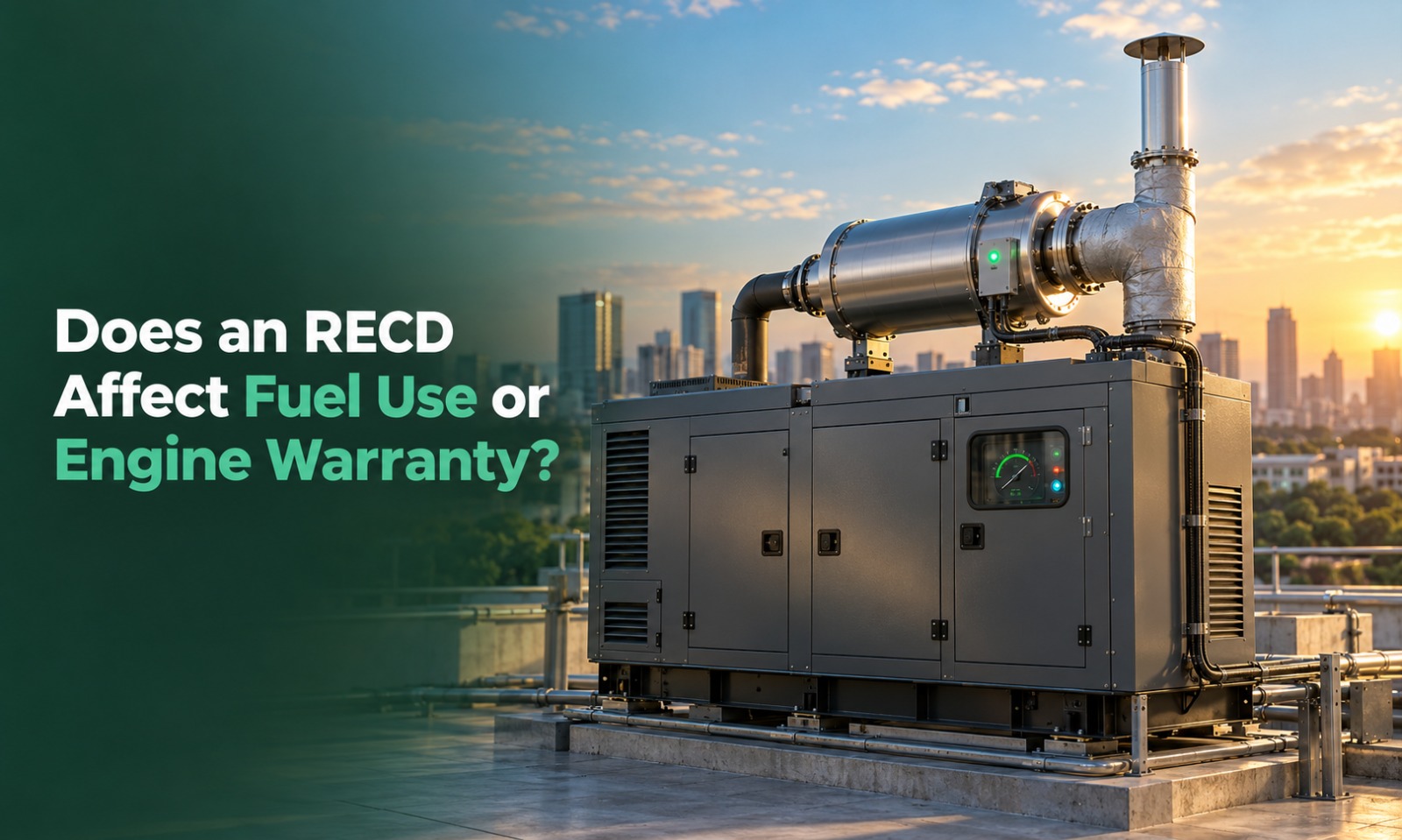
RECD for hospitals is rarely a question of whether a generator is needed. The real question is how to keep backup power dependable while meeting air-quality rules. The same applies to data centres, housing societies and malls. All of them rely on diesel gensets that run rarely but cannot fail, and all now sit under rules that expect those sets to control particulate emissions. A retrofit emission control device (RECD) is the route most boards recognise for in-use sets up to 800 kW. This guide walks through what each sector faces and how to approach it.
The rules in brief
Requirements differ by state, so treat this as a map, not legal advice. In the Delhi-NCR, CAQM's schedule asks sets from 41 kW to below 800 kW to run dual-fuel or fit a certified RECD, while sets of 800 kW and above need an emission-control mechanism and must meet stack standards. Maharashtra's circular covers sets up to 800 kW (1,000 kVA) that are more than five years old, and Karnataka's covers 61 to 800 kW on the same age basis.
A certified RECD must deliver at least 70% particulate reduction, certified by an agency such as ARAI or ICAT, and should come from a vendor on the CPCB list. Always check the latest circular for your location.
Hospitals: backup that cannot blink
A hospital's generators carry operating theatres, ICUs, imaging and cold storage. They must start within seconds, and many sets are old because they were installed years ago and rarely run for long.
The main risk during a retrofit is losing redundancy. Plan the work set by set, keep one tested set on standby throughout, and schedule installation in low-demand windows. Ask the vendor for a post-installation load test, and confirm the device's back-pressure sits within the engine maker's limit so starting reliability is not affected. Some directions treat emergency services differently, so check how your board classifies hospital backup.
Data centres: big sets, strict uptime
Data centres run N+1 or 2N generator banks and test them on a regular schedule, so run hours add up even without outages. The catch is size. Many sets are 800 kW or larger, which falls outside the capacity an RECD is certified for, so stack standards and other emission-control options apply instead.
Start with an audit of every set's gross kW. Sets below 800 kW can follow the RECD route, while larger ones need a conversation with your pollution control board. Check OEM warranty terms and any customer SLA clauses before work begins.
Housing societies: many voices, one budget
Society generators, often in the 62.5 to 250 kVA range, run lifts, water pumps and common lighting during outages. The challenge is usually governance, not engineering: the managing committee must approve the spend, residents want to know about noise and downtime, and the funds come from the maintenance corpus.
Get quotes from at least two CPCB-listed vendors, share the device certificate with residents, and plan installation for a time when outages are unlikely. Keep the records, because inspections can lead to sealing and compensation, as CAQM has shown with non-compliant sets in the NCR.
Malls: many sets, high visibility
Malls run several large sets across a campus for escalators, HVAC and common areas, and a sealed generator is a public embarrassment. Fleet management is the issue. Survey every set, standardise on certified devices where kW ranges allow, stagger installation so tenants stay powered, and tie the results into your ESG reporting.
At a glance by sector
Sector | Main concern | First step |
|---|---|---|
Hospitals | Losing redundancy during work | Retrofit one set at a time |
Data centres | Sets of 800 kW and above | Audit gross kW for every set |
Housing societies | Approvals and budget | Compare two or three CPCB-listed vendors |
Malls | Large fleets and tenants | Survey and stagger installation |
How to choose a vendor
Look for a vendor on the CPCB RECD list, a certificate covering your kW range and engine phase, back-pressure data, a post-installation emission test, an AMC and references from similar sites.
Mistakes to avoid
Assume one certificate covers every set, ignore sets of 800 kW and above, skip the OEM warranty check, keep no records, and wait until the deadline when certified supply is tight.
Next step
Whatever the sector, the process starts with a list of your sets: kW, phase, year, and warranty status. Novorbis Itus is on the CPCB RECD vendor list (as of 30-06-2026). Share your list and we will confirm which sets need a retrofit and which devices fit.